
By Suha (@recreationalspice) and Burakashi
This article presents the key findings of our reader survey on the Experiences of Queer and Religiously Diverse Maldivians (n=96), conducted via Crowdsignal between February 17 – May 1, 2025. The final sample size only includes the 96 respondents (out of a total of 130) who fully completed the survey. The data reveals a profound discrepancy between the Maldives’ international image as a luxury, and queer friendly, tourist destination and the lived realities of its marginalised citizens.
- Who answered the survey?
- Experiences of public self-expression, visibility and discrimination
- Support networks and community engagement
- Rights, representation and advocacy
- Perceptions of the international community
- Summary
Who answered the survey?
This section provides a brief description of the cohort that answered the survey. The overwhelming majority of respondents identify as Dhivehi/Maldivian apart from two respondents who respectively felt “conflicted” or considered themselves “not legally a Maldivian…reason being the law mandates to be a citizen you have to be a Muslim”. Most respondents are young adults under 35 years of age (84%).
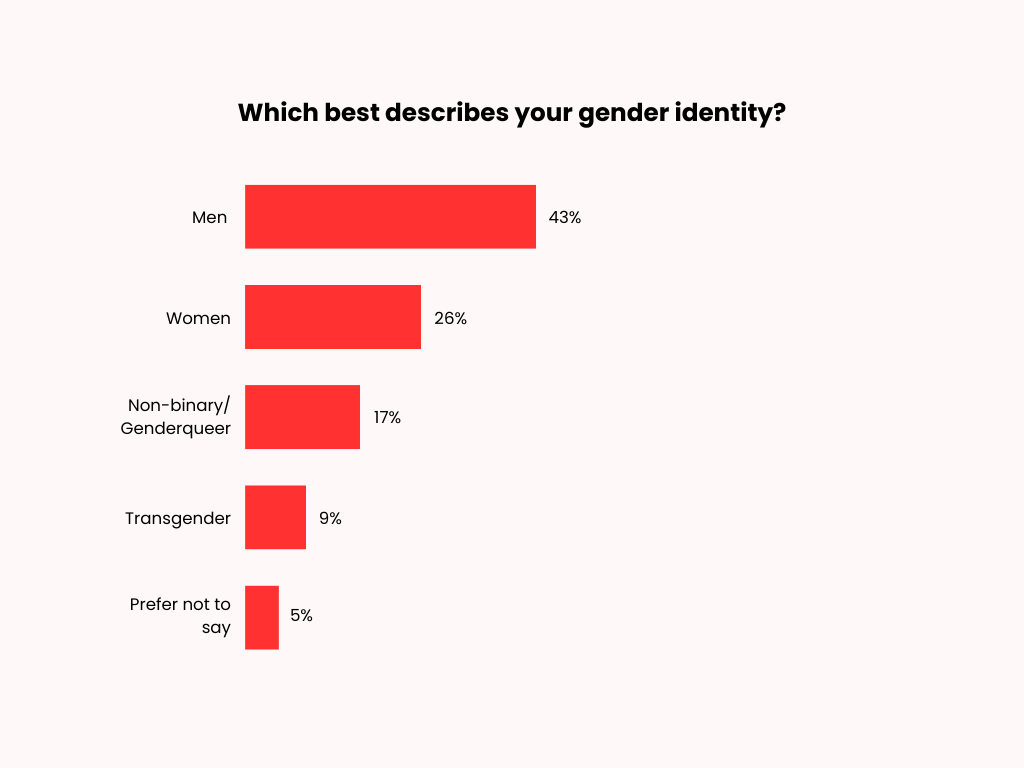
Forty-three percent of respondents identify as men, followed by women (26%), non-binary/genderqueer individuals (17%), and transgender individuals (9%). A small proportion of respondents (5%) preferred not to disclose their gender identity.
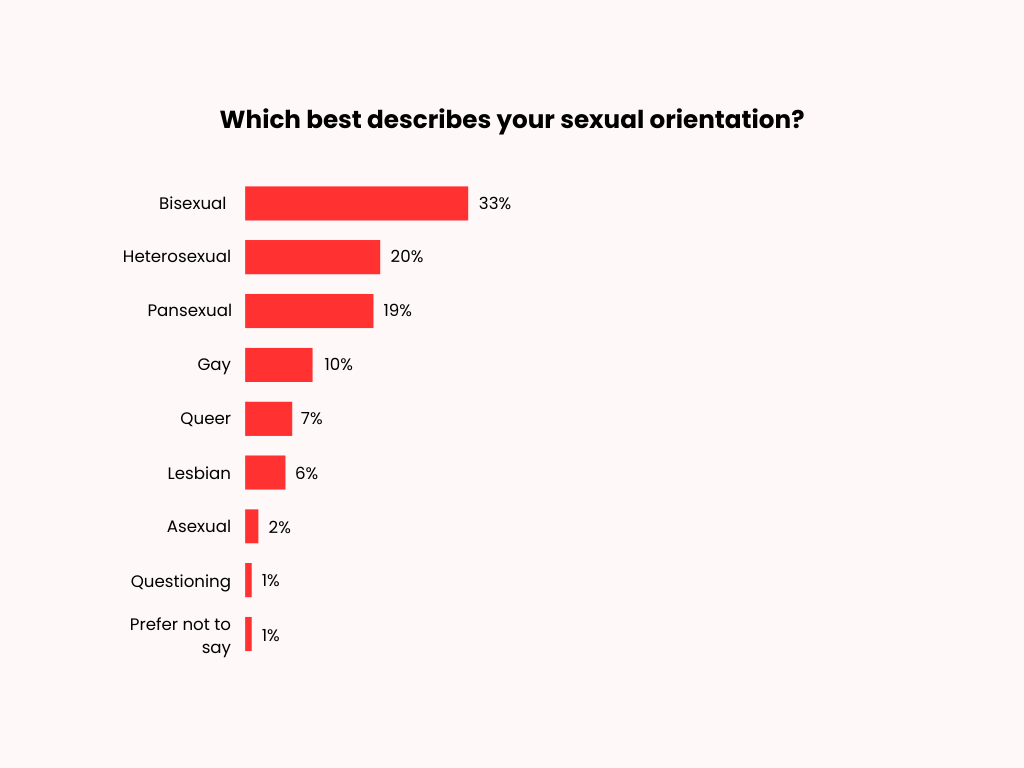
Most identify as bisexual (33%) followed by heterosexual (20%), pansexual (19%), gay (10%), queer (7%), lesbian (6%), asexual (2%) and questioning (1%).
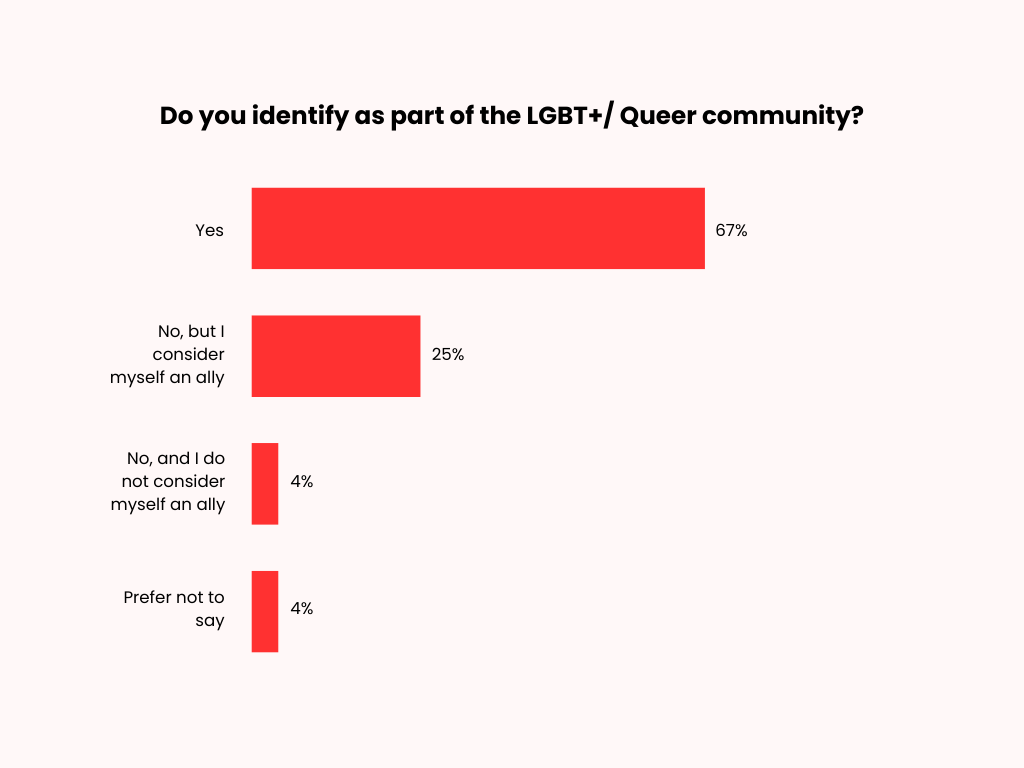
A substantial proportion of respondents identify as part of the LGBTQ+ community (67%), while many identify as allies (25%). Only 4 percent not consider themselves an ally while 4% prefer not to disclose whether they identify as part of the LGBTQ+ community.
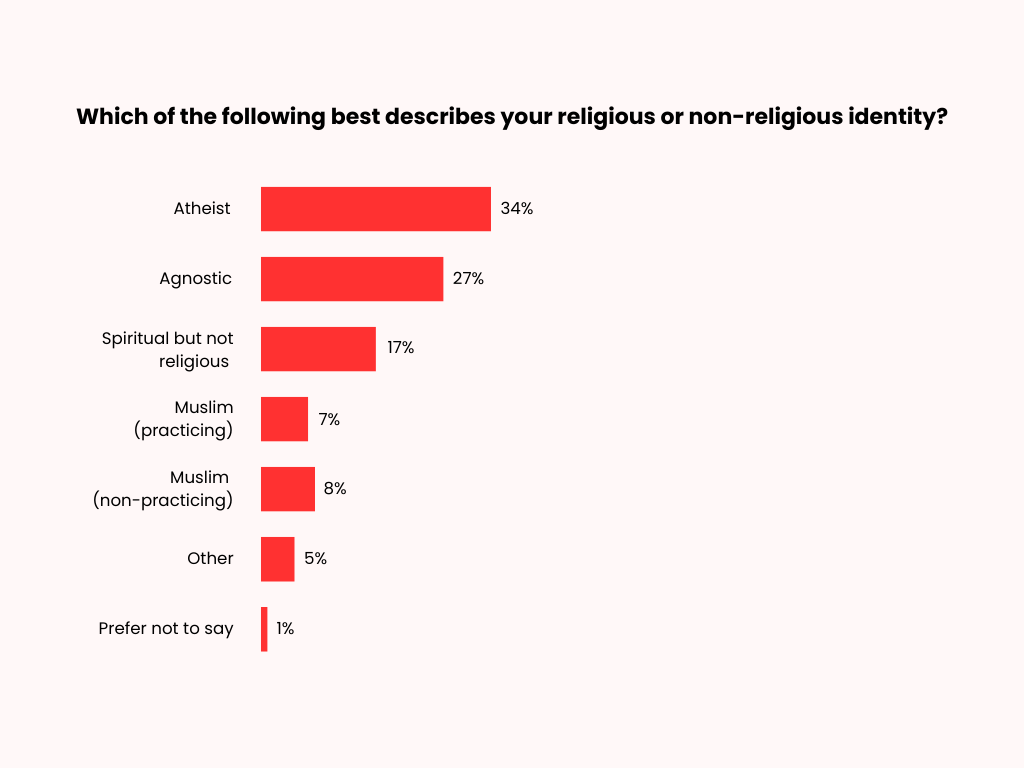
Non-religious beliefs are prevalent among respondents, with the majority identifying as atheist (34%), agnostic (27%), or spiritual but not religious (17%). A smaller proportion of respondents identify as Muslim (15%), including those who are non-practising (8%) and practising (7%).
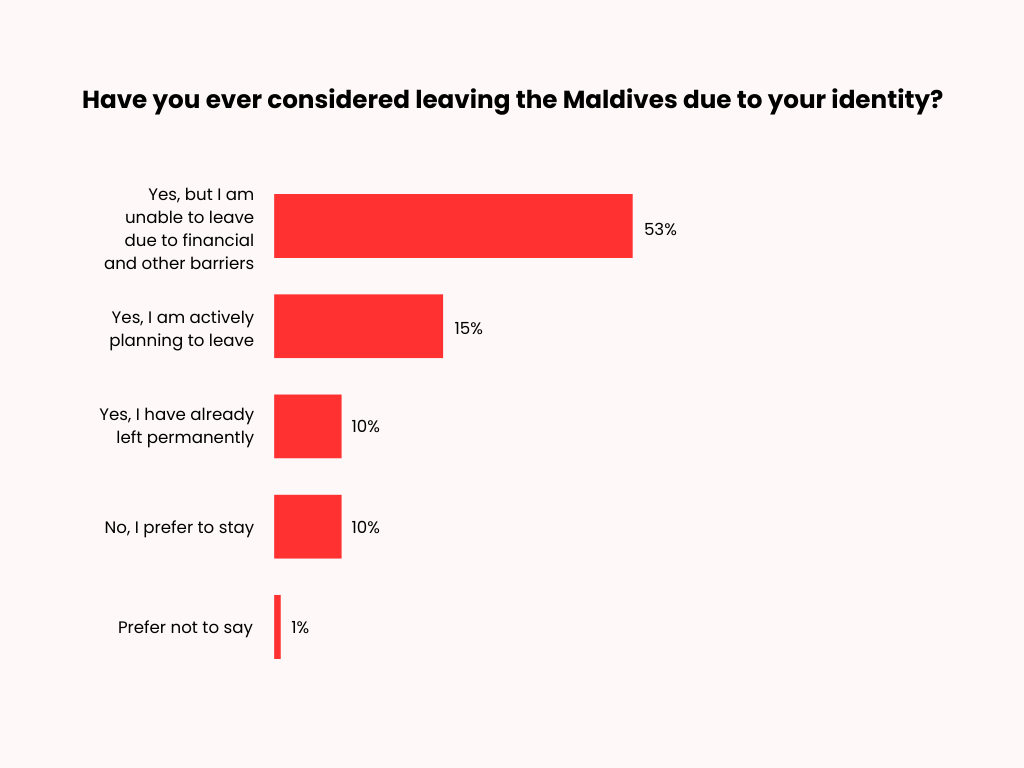
Most respondents have considered leaving the Maldives due to their identity (88%). However, half of respondents (50%) report being unable to leave due to financial and other barriers. A smaller proportion are actively planning to leave (24%), while others have already left permanently (10%). One percent of respondents preferred to not say.
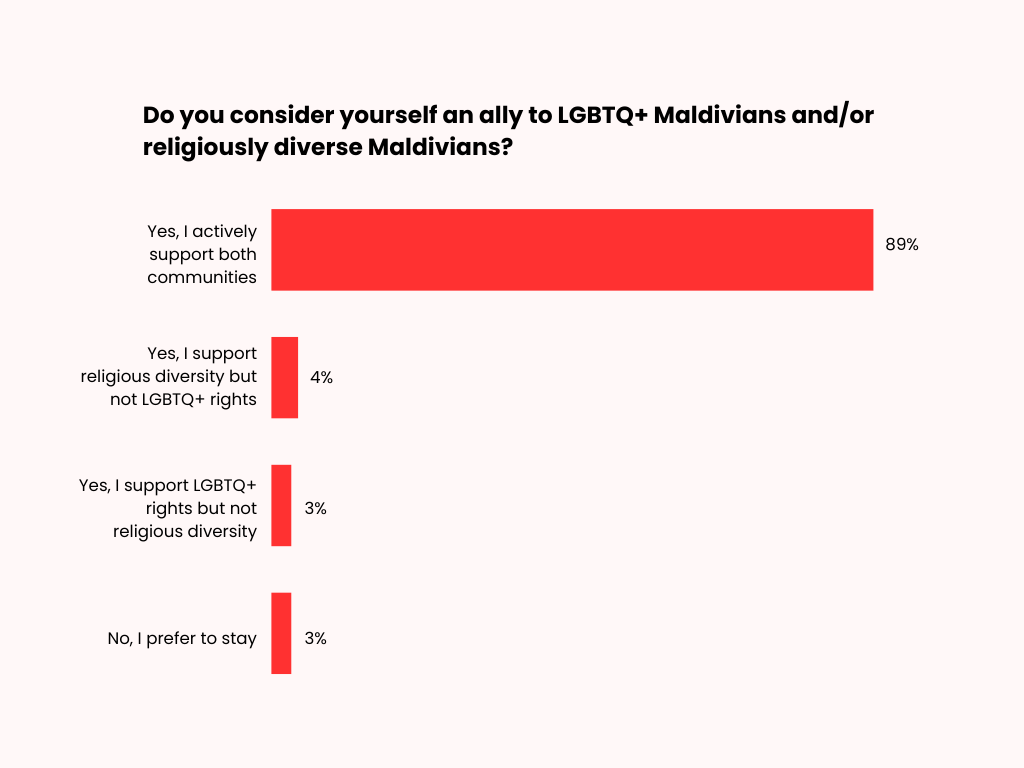
A clear majority of respondents also identify as allies to LGBTQ+ and/or religiously diverse Maldivians and report actively supporting both communities (89%). A small proportion of respondents support religious diversity but not LGBTQ+ rights (4%), or support LGBTQ+ rights but not religious diversity (3%). A further 3% of respondents preferred not to disclose their views.
The survey captures the perceptions of a community that is highly marginalised, relatively young and politically and socially aware. Although the survey does not capture the views of a nationally representative sample or general public opinion, the results reflect the lived experiences and human rights reality of queer and religiously diverse Maldivians. Many view migration not as an aspiration but as a necessary escape route which reflects a profound sense of hopelessness and systemic insecurity.
Experiences of public self-expression, visibility and discrimination
Public self-expression and visibility are central to the lived experiences of marginalised communities, yet they often carry significant risks. This section explores how queer and religiously diverse Maldivians navigate safety, identity concealment and discrimination in their daily lives. It examines respondents’ perceptions of personal safety when expressing their sexual orientation, gender identity or religious beliefs, the frequency with which they conceal aspects of their identity, and their experiences of discrimination from family, friends and broader social networks. Additionally, it considers respondents’ willingness to speak out against discrimination, highlighting the complex interplay between visibility, vulnerability and social pressures.
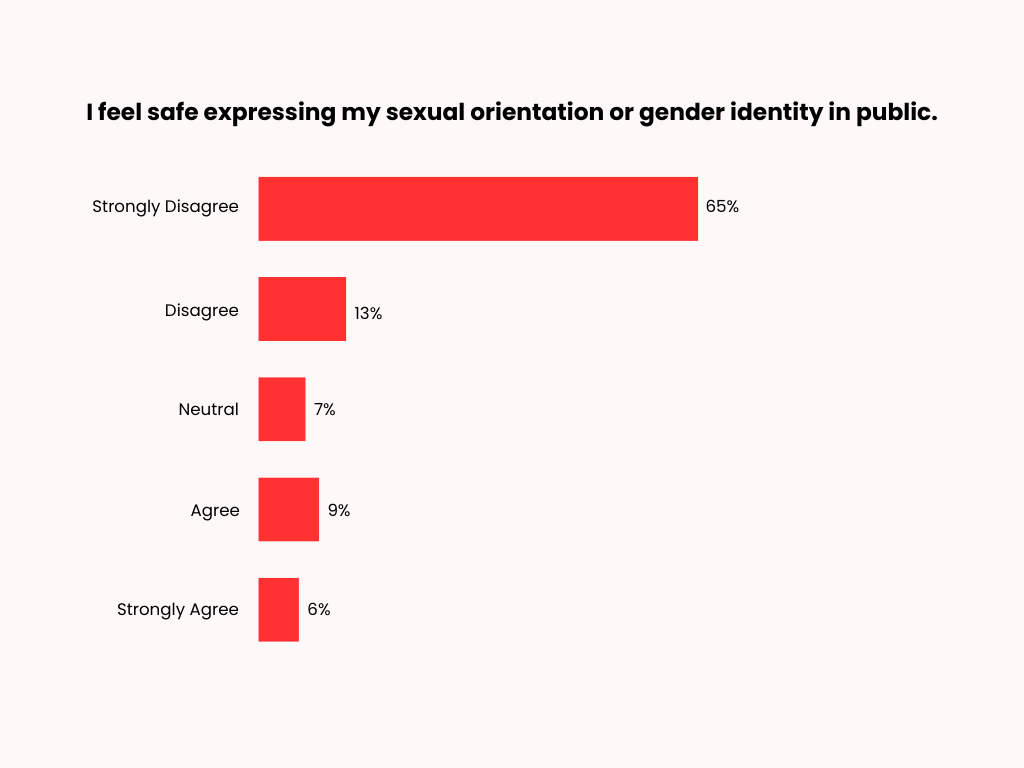
The majority of respondents report extremely low feelings of safety when expressing their gender identity or sexual orientation in public. Sixty-five percent strongly disagree with the statement that they feel safe expressing their sexual orientation or gender identity in public, while 13% disagree and 7% remain neutral. In contrast, only 9% agree with the statement, and 6% strongly agree.
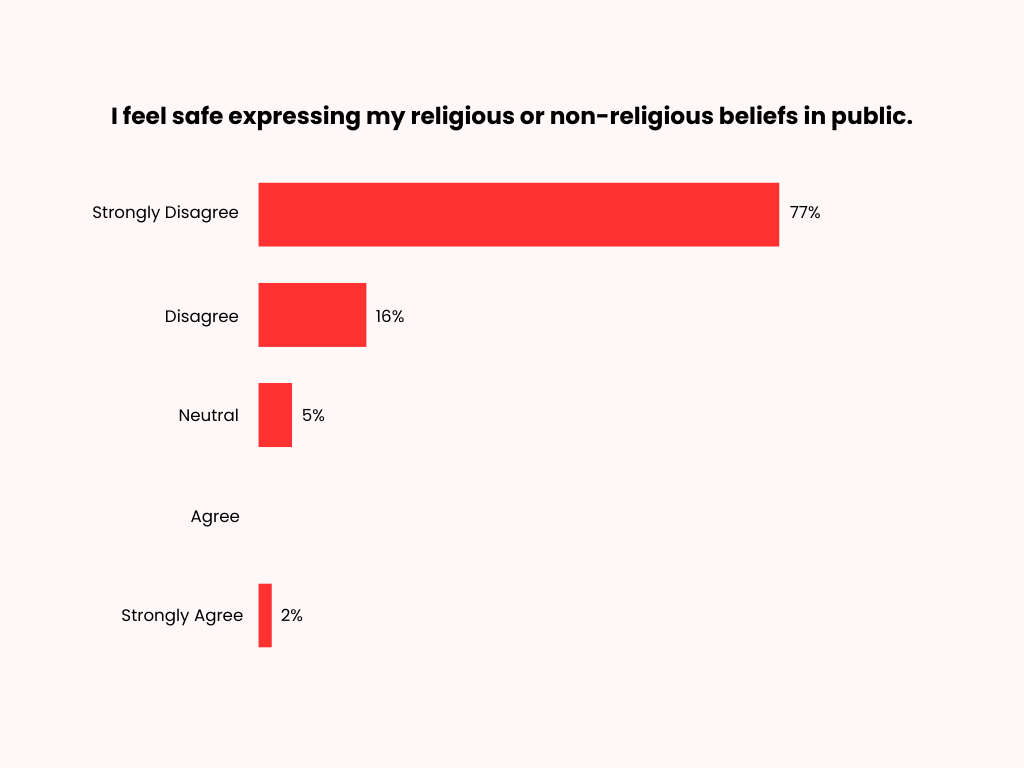
Similarly, 77% of respondents strongly disagree with the statement that they feel safe expressing their religious or non-religious beliefs in public. Sixteen percent disagree, 5% remain neutral, and only 2% strongly agree.
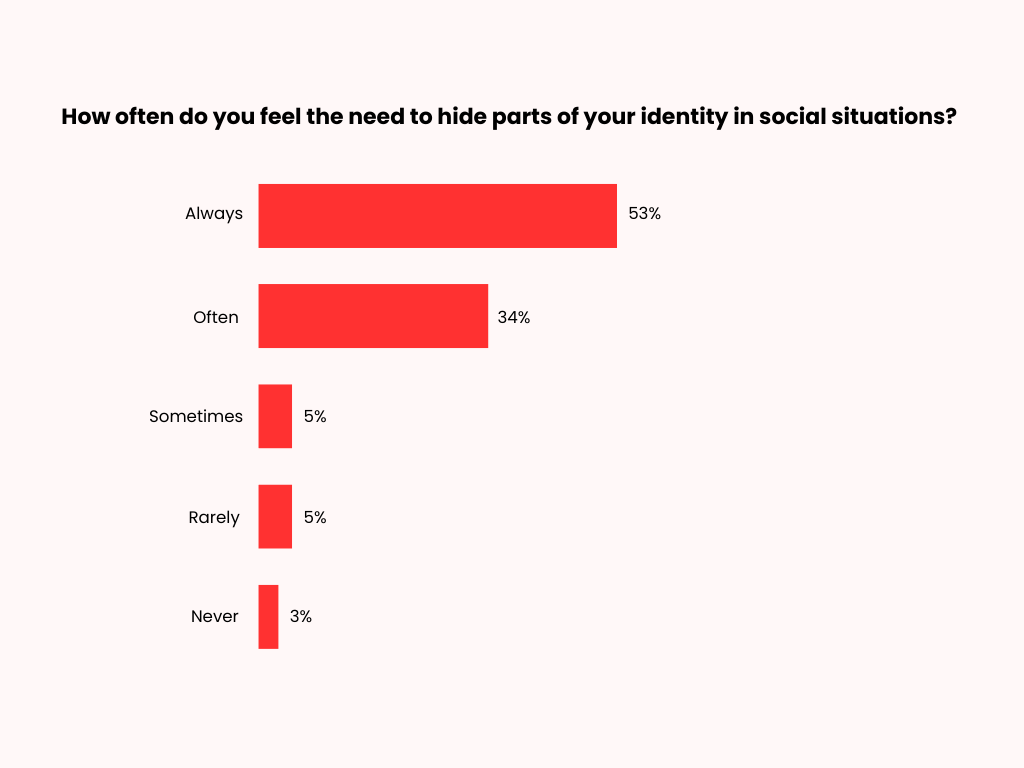
Most respondents reported having to always (53%) or often (34%) hide parts of their identity in social situations. In contrast, only a small proportion indicated that they sometimes (5%), rarely (5%), or never (3%) had to conceal aspects of their identity in social situations.
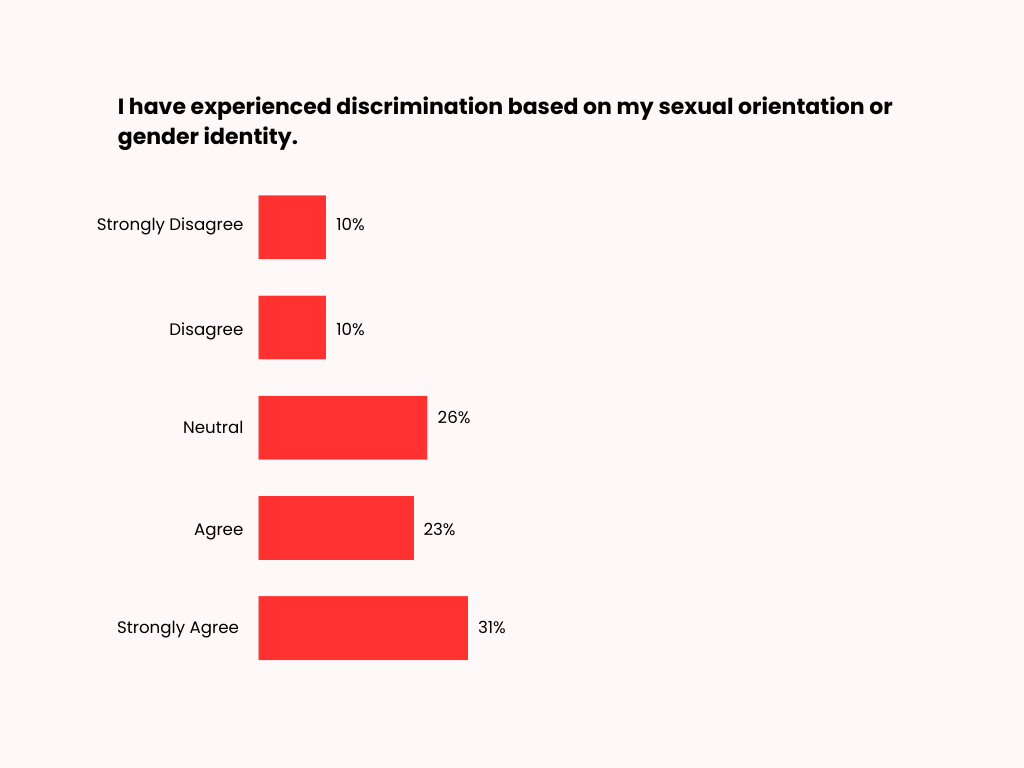
Thirty-one percent of respondents strongly agree that they have experienced discrimination based on their sexual orientation or gender identity, and 23% agree. Twenty-six percent remain neutral, while 10% either disagree or strongly disagree.
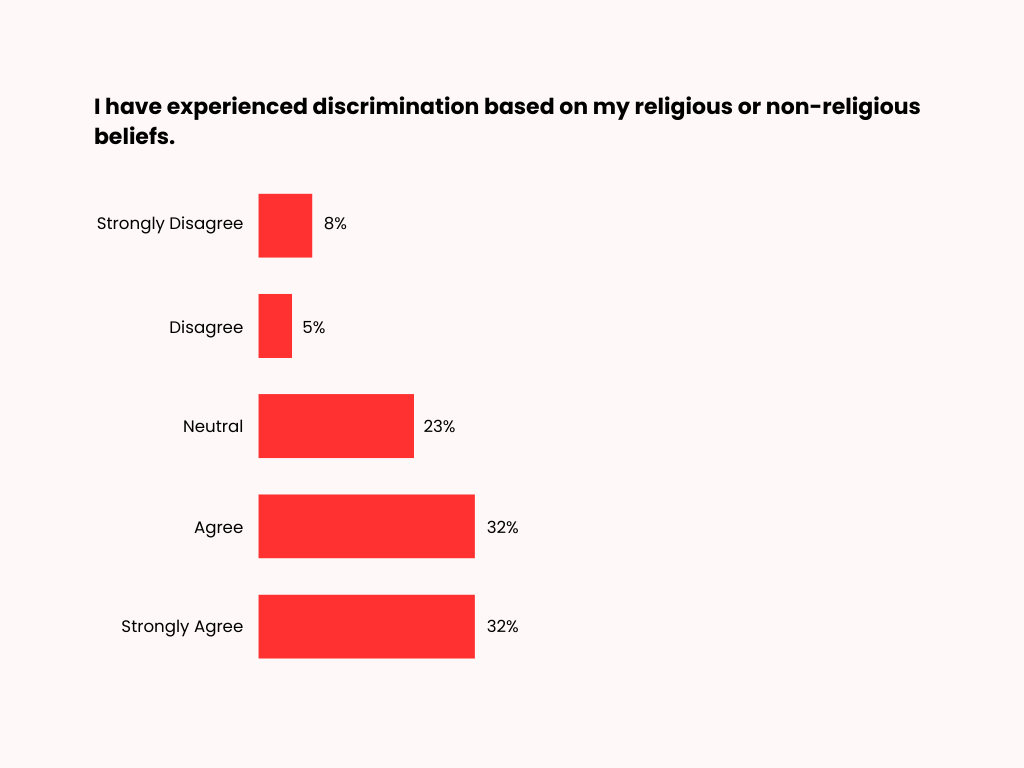
Thirty-two percent of respondents strongly agree that they have experienced discrimination based on their religious or non-religious beliefs, with a further 32% agreeing. Twenty-three percent remain neutral, while 5% disagree and 8% strongly disagree.
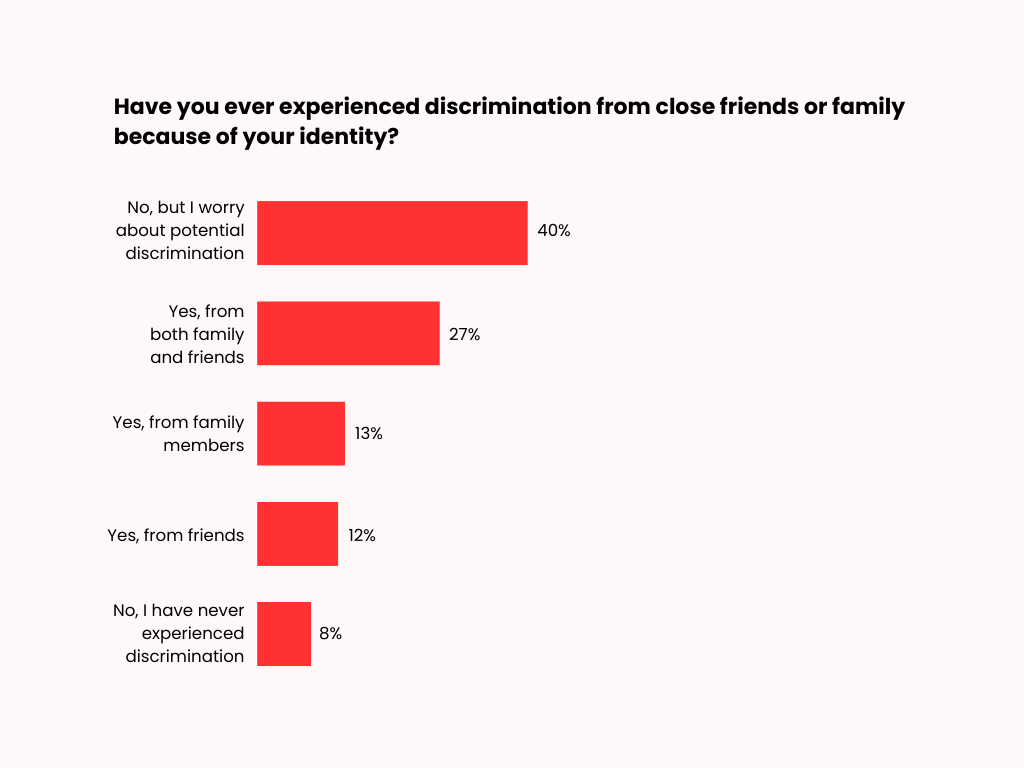
Most respondents worry about potential discrimination from close friends or family because of their identity (40%), while 27% report having experienced discrimination from both family and close friends. Thirteen percent have experienced discrimination from family members, and 12% from friends. Only 8% of respondents report never having experienced discrimination from close friends or family because of their identity.
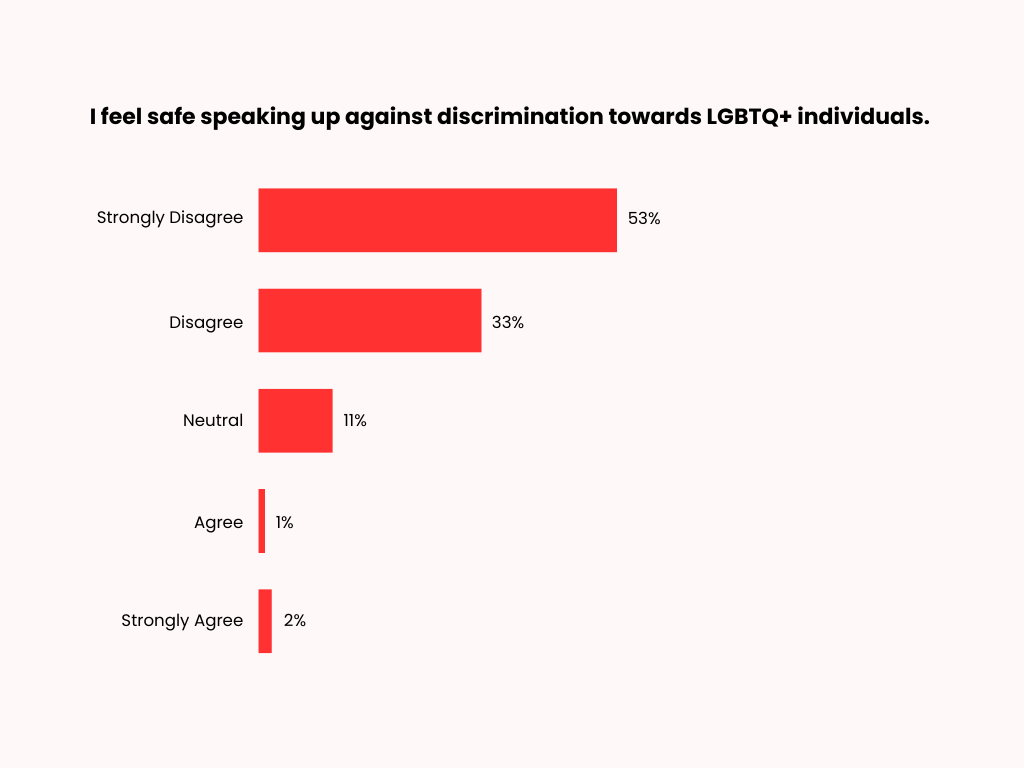
Overwhelmingly, respondents strongly disagree (53%) or disagree (33%) that they feel safe speaking up against discrimination toward LGBTQ+ individuals. Ten percent report neutral views, while only a small proportion agree (1%) or strongly agree (2%).
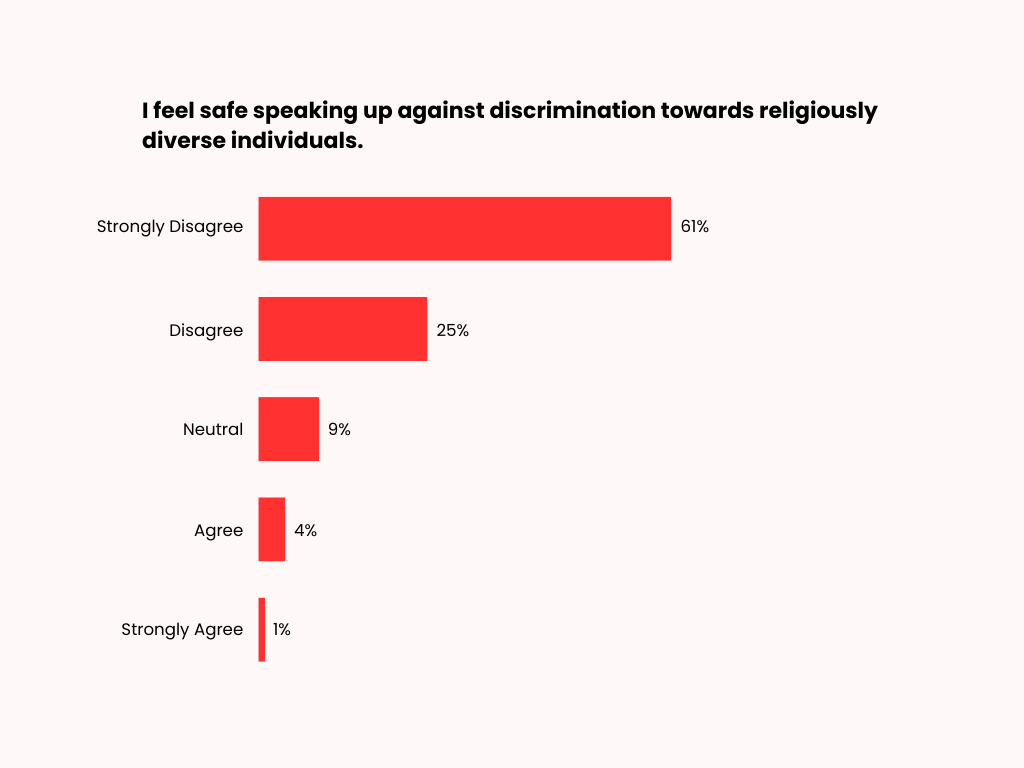
The majority of respondents strongly disagree (61%) or disagree (25%) that they feel safe speaking up against discrimination toward religiously diverse individuals. A small proportion remain neutral (9%), agree (4%), or strongly agree (1%).
These findings point to a social environment characterised by pervasive fear. Safety and protection from discrimination is contingent on self-censorship. Experiences of discrimination are also common and multidimensional highlighting the institutionally embedded and deeply social nature of the repression of LGBTQ+ and religious/non-religious minorities. Discrimination is not abstract or just at an institutional level. It is intimate, and happens at home, between friends and in families.
Support networks and community engagement
Social support and community connections are vital for the well-being of queer and religiously diverse individuals, particularly in contexts where public visibility carries the risk of harm. This section examines respondents’ experiences with disclosure, support and community engagement. It examines who they turn to for understanding and affirmation of their identities and explores comfort levels in sharing personal aspects of identity with family and friends, the types of communities that provide support, and the frequency of engagement with LGBTQ+ and religiously diverse networks both online and in person. The section also considers key sources of information about identity-related issues, illustrating how social and digital networks shape access to knowledge, connection and resilience.
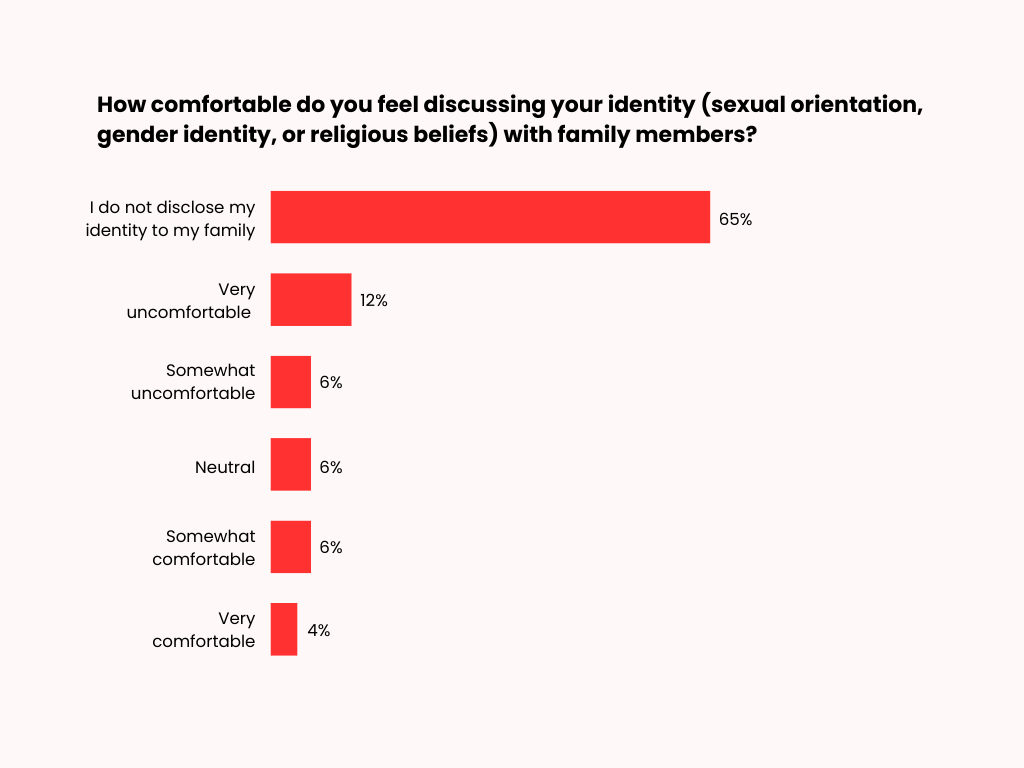
The majority of respondents have not disclosed their identity to their family members (65%). Some feel very uncomfortable (12%) or somewhat uncomfortable (6%) revealing their identity, while a smaller proportion feel somewhat comfortable (6%) or very comfortable (4%). An additional 6% remain neutral regarding disclosure to family members.
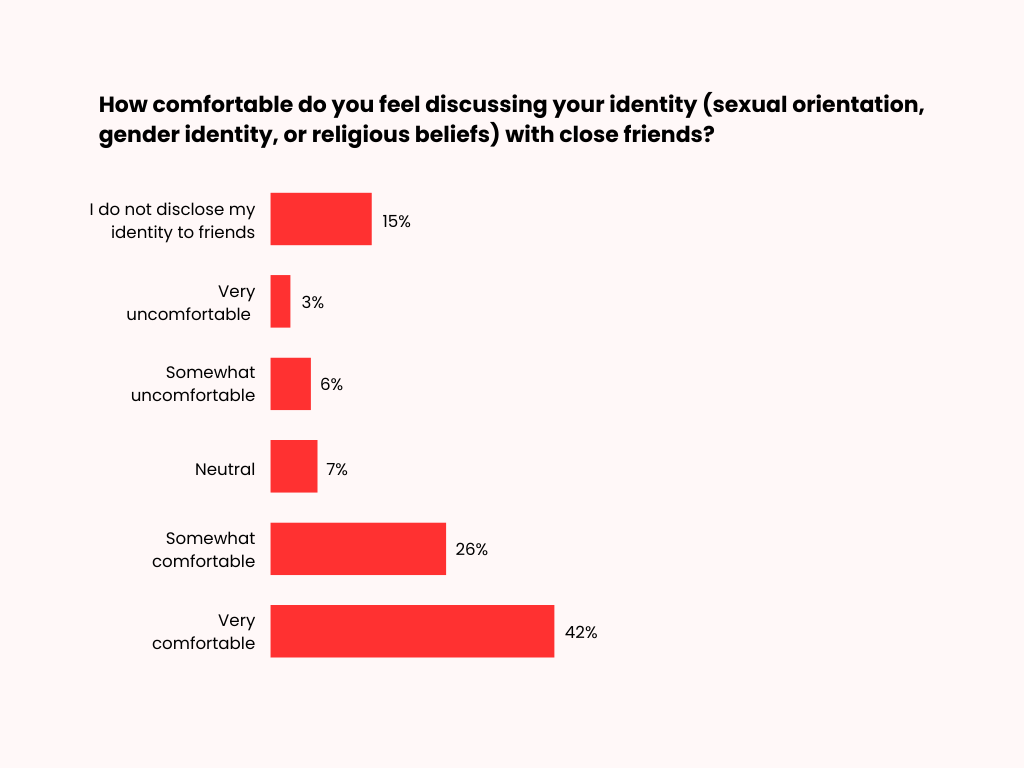
The majority of respondents feel comfortable discussing their identity (sexual orientation, gender identity, or religious beliefs) with close friends (42%), while 26% feel somewhat comfortable. Some respondents report not disclosing their identity to friends (15%). A few feel neutral (7%), somewhat uncomfortable (6%), or very uncomfortable (3%).
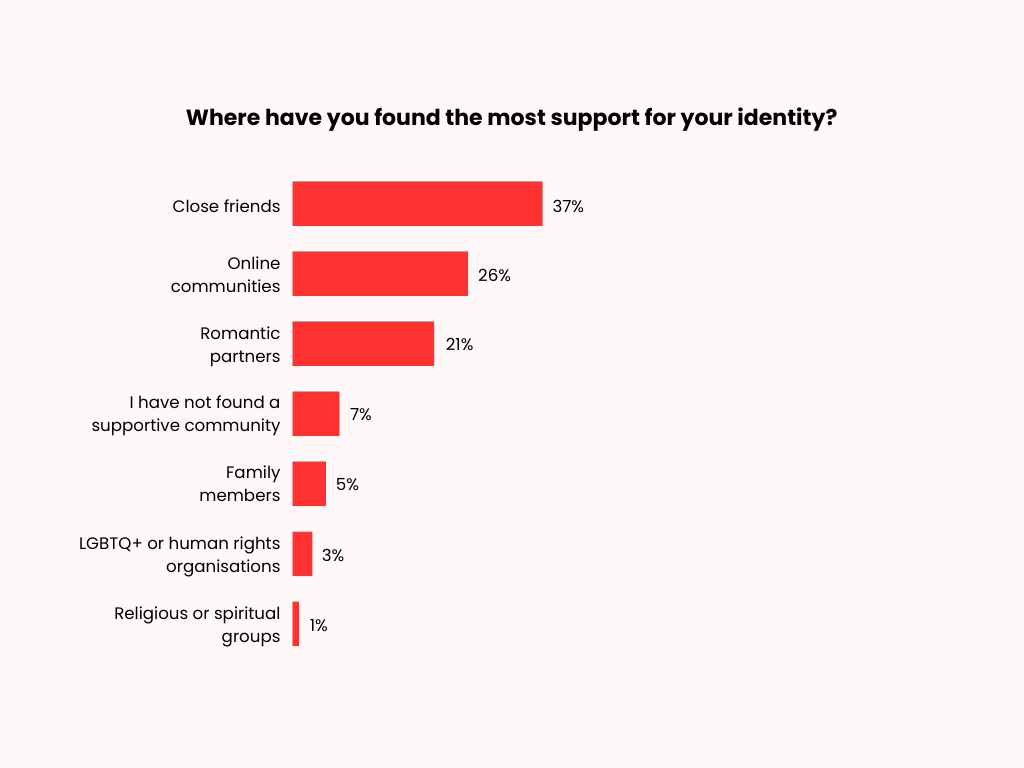
While most respondents report finding the most support for their identity from close friends (37%), a substantial number have found support in online communities (26%) or from romantic partners (21%). Some respondents have not found a community supportive of their identity (7%), and smaller proportions report receiving support from family members (5%), LGBTQIA+ or human rights organisations (3%), and religious or spiritual groups (1%).
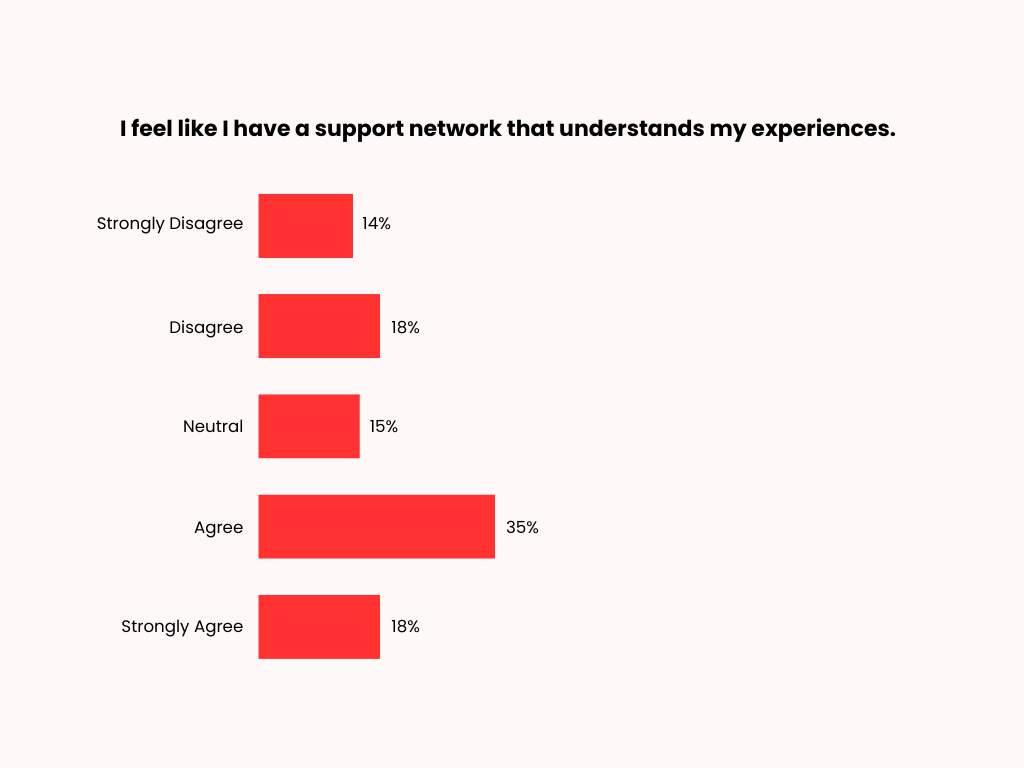
Fourteen percent of respondents strongly disagree that they have a support network that understands their experiences, while 18% disagree. Fifteen percent remain neutral, whereas 35% agree and 18% strongly agree.
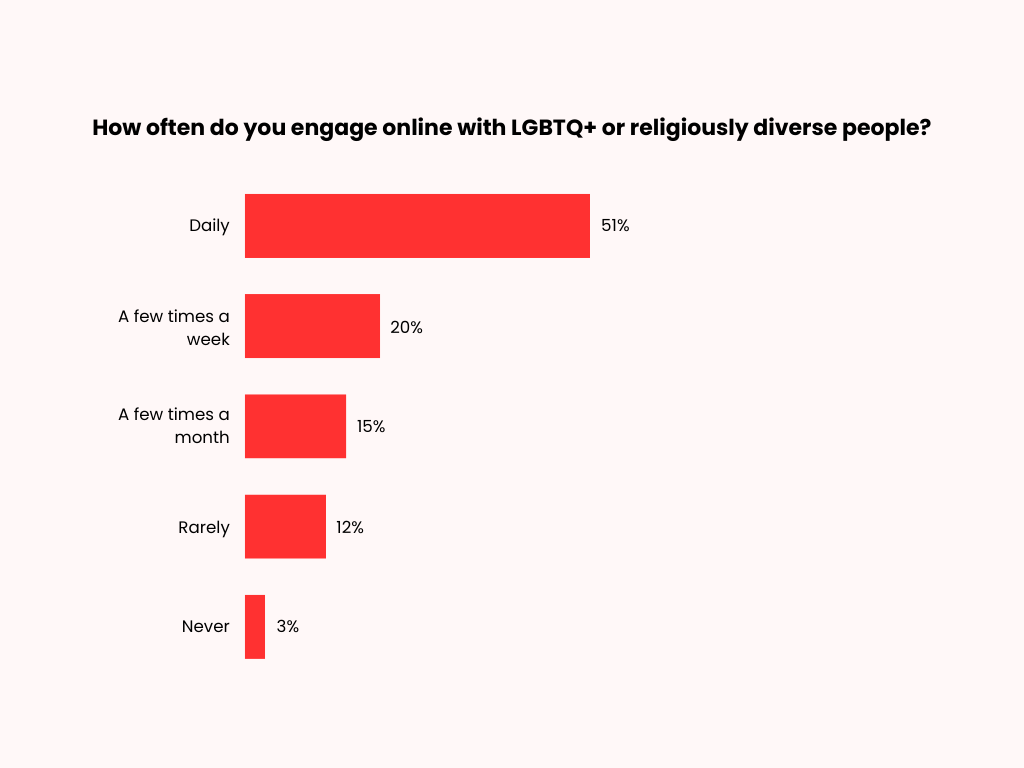
The majority of respondents engage with LGBTQ+ and religiously diverse people online daily (51%), while others do so a few times a week (20%), a few times a month (15%), or rarely (12%). Only a small proportion report ever engaging with LGBTQ+ or religiously diverse people online (3%).

Most respondents report engaging with LGBTQ+ and religiously diverse people in person on a daily basis (45%), followed by those who do so a few times a week (18%), rarely (17%), or a few times a month (11%). Only a small proportion of respondents never engage with LGBTQ+ and religiously diverse people in person (9%).
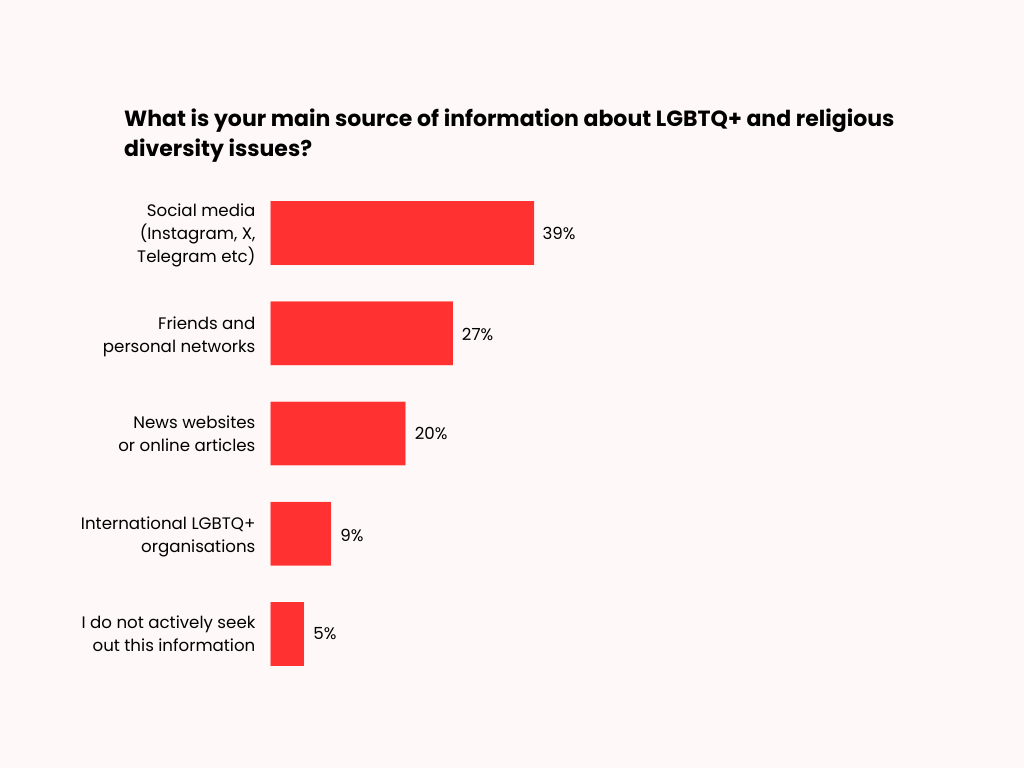
For many respondents, the main sources of information about LGBTQ+ and religious diversity issues are social media (39%), friends and personal networks (27%), and news websites or online articles (20%). Only a small proportion rely on international LGBTQ+ organisations as their primary source of information (9%), while a minority do not actively seek out this information (5%).
The findings indicate that respondents generally feel more comfortable discussing their identity with friends than with family, with a significant proportion not disclosing their identity to family members. Close friends, online communities and romantic partners are the primary sources of support, while family, formal organisations and religious groups play a limited role. Although some respondents report lacking a support network that understands their experiences, the majority feel at least somewhat supported.
Engagement with LGBTQ+ and religiously diverse communities is high, both online and in person, with daily or weekly interactions being common. Social media, friends and online news are the main sources of information about LGBTQ+ and religious diversity issues. Reliance on formal international organisations is comparatively low. Overall, these findings highlight the importance of peer networks and online spaces in providing support and information for identity-related experiences.
Rights, representation and advocacy
Legal protections, public representation and opportunities for advocacy are central to the realisation of equal rights and social inclusion. This section examines respondents’ perceptions of legal safeguards for queer and religiously diverse Maldivians. This includes respondents’ confidence in accessing justice and their views on equality and education and media representation. It also explores attitudes toward advocacy and civic engagement, including the conditions under which respondents feel able to support LGBTQ+ and religious diversity causes. This section also considers levels of optimism about future change, revealing the tension between strong commitments to equality and the structural, legal and social barriers that constrain visible action.
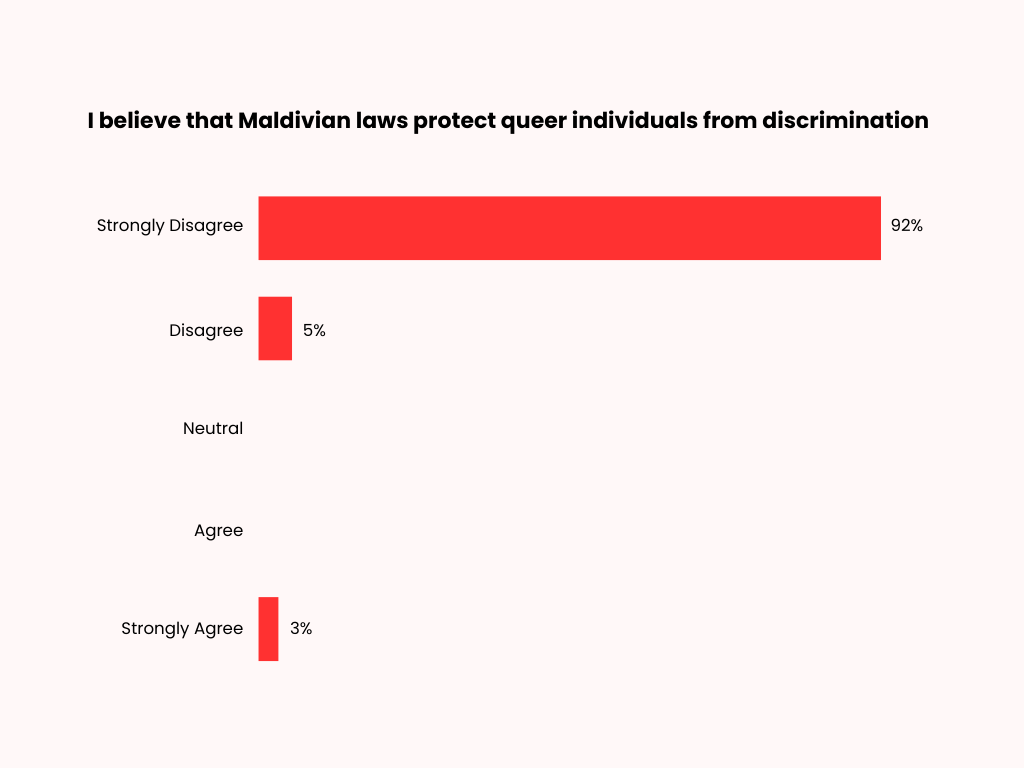
An overwhelming majority of respondents strongly disagree (92%) that Maldivian laws protect queer individuals from discrimination, while 5% disagree. Only a small proportion strongly agree with this statement (3%).
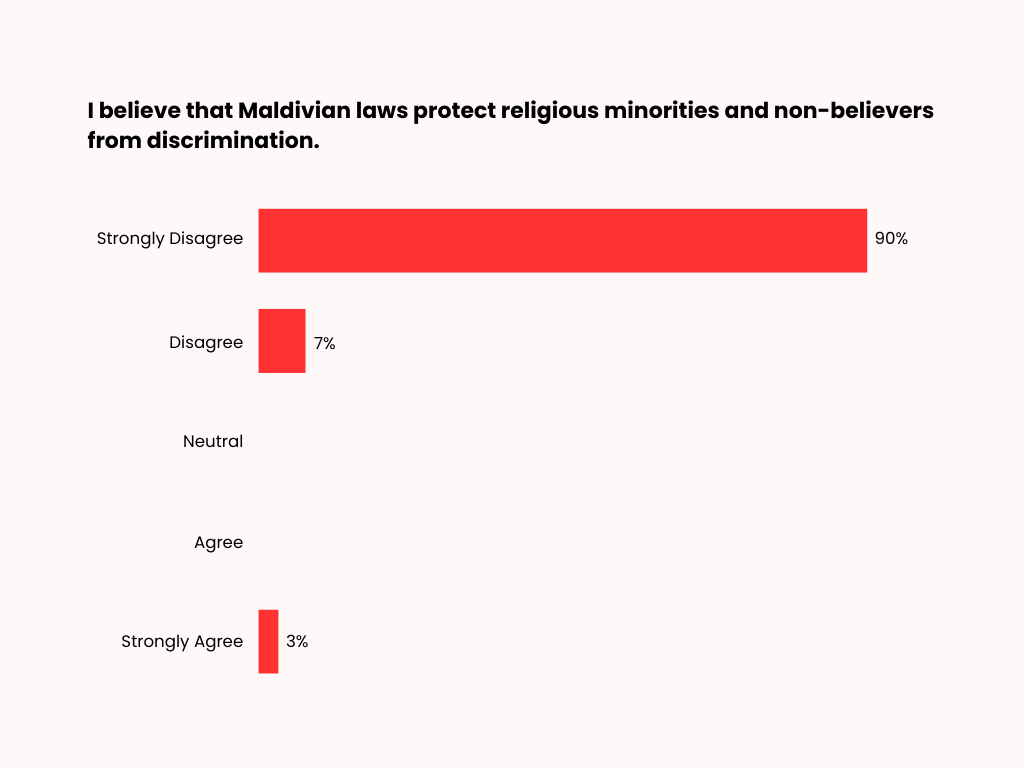
Similarly, 90% of respondents strongly disagree and 7% disagree that Maldivian laws protect religious minorities and non-believers from discrimination. Only a small proportion strongly agree with this statement (3%).
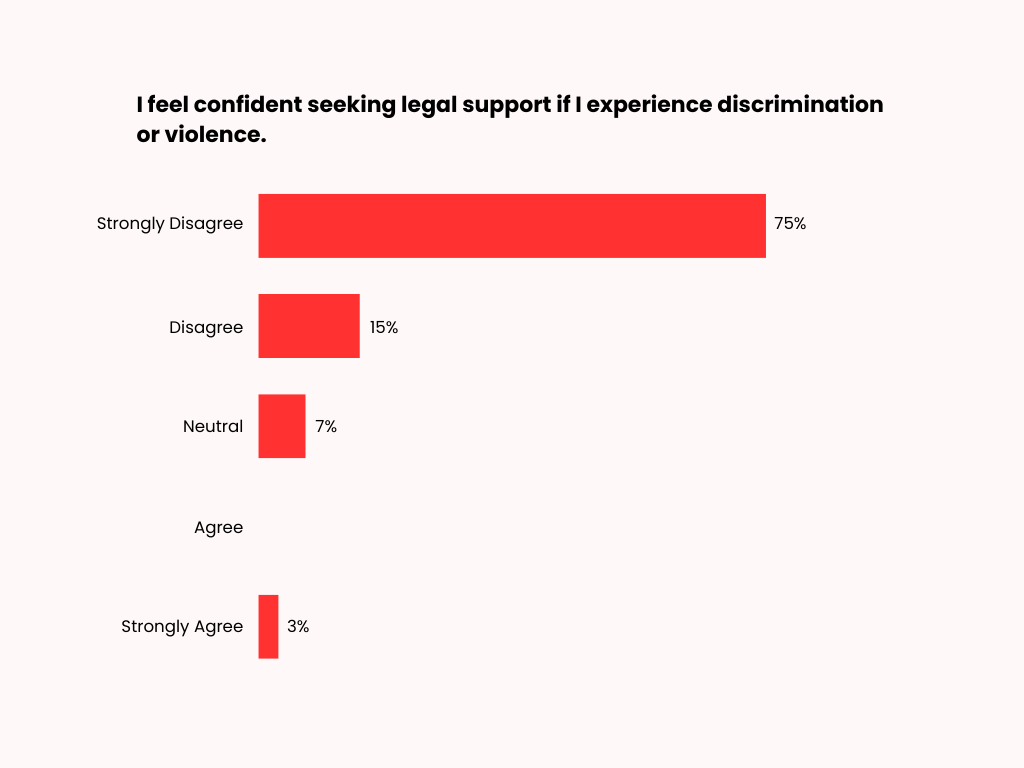
Most respondents strongly disagree (75%) or disagree (15%) that they feel confident seeking legal support if they experience discrimination or violence. Seven percent remain neutral, while only 3% strongly agree.
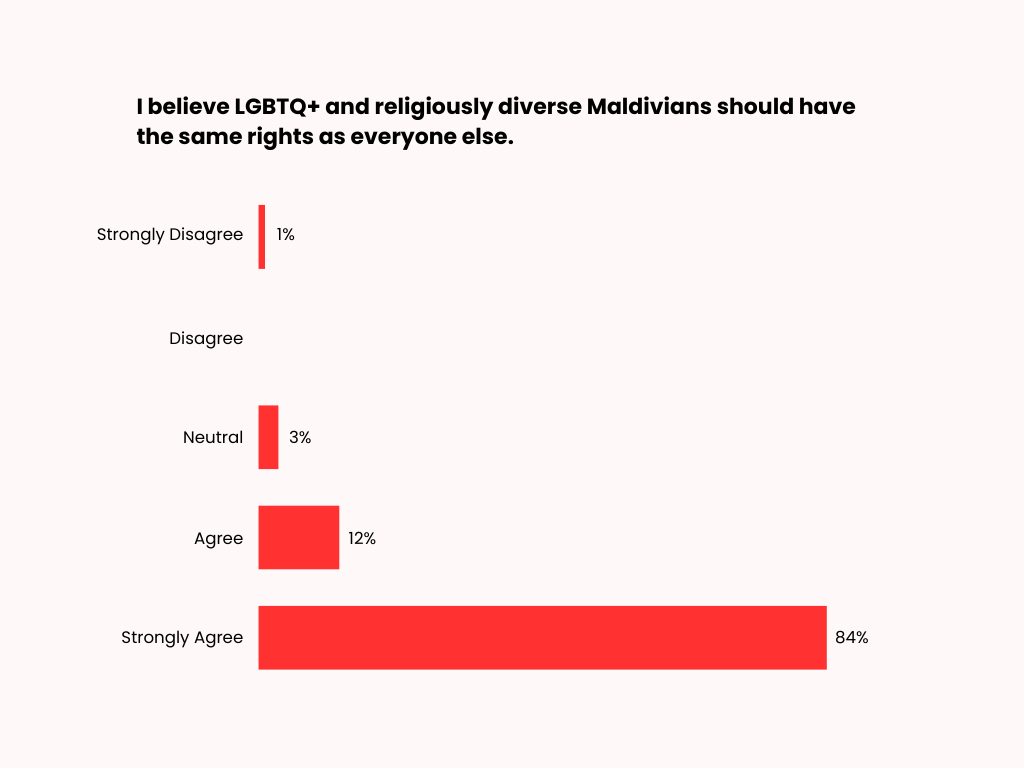
There is strong support for LGBTQ+ and religiously diverse Maldivians to have equal rights. The majority of respondents strongly agree (84%) or agree (12%) that these groups should have the same rights as everyone else. Three percent remain neutral, and only 1% strongly disagree.
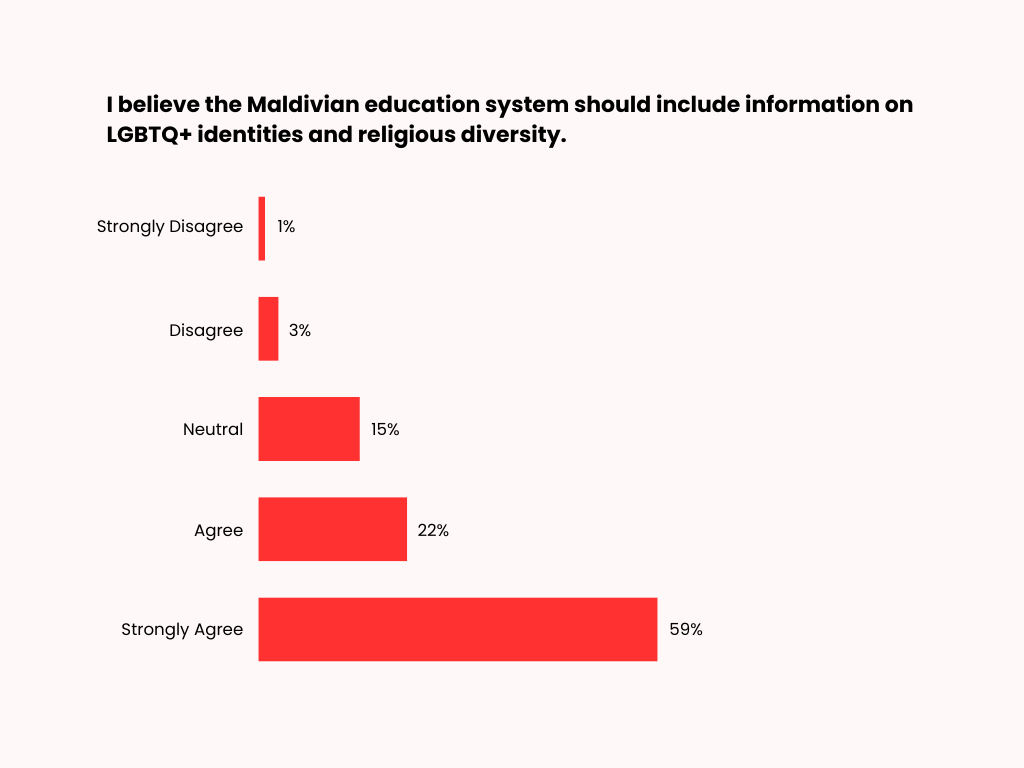
Most respondents support the inclusion of information on LGBTQ+ identities and religious diversity in the Maldivian education system. Fifty-nine percent strongly agree and 22% agree that such content should be included, while 15% remain neutral. Only a small proportion of respondents disagree (3%) or strongly disagree (1%).
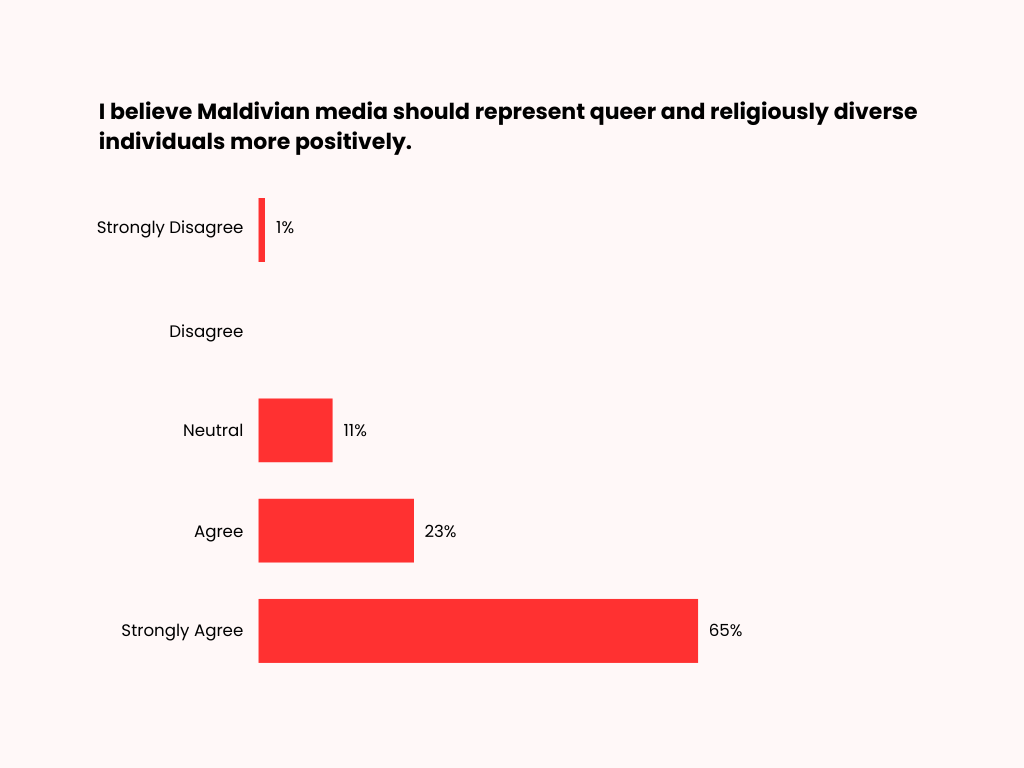
Most respondents believe that Maldivian media should represent queer and religiously diverse individuals more positively. Specifically, 65% strongly agree with this statement, while 23% agree and 11% remain neutral. Only 1% strongly disagree.
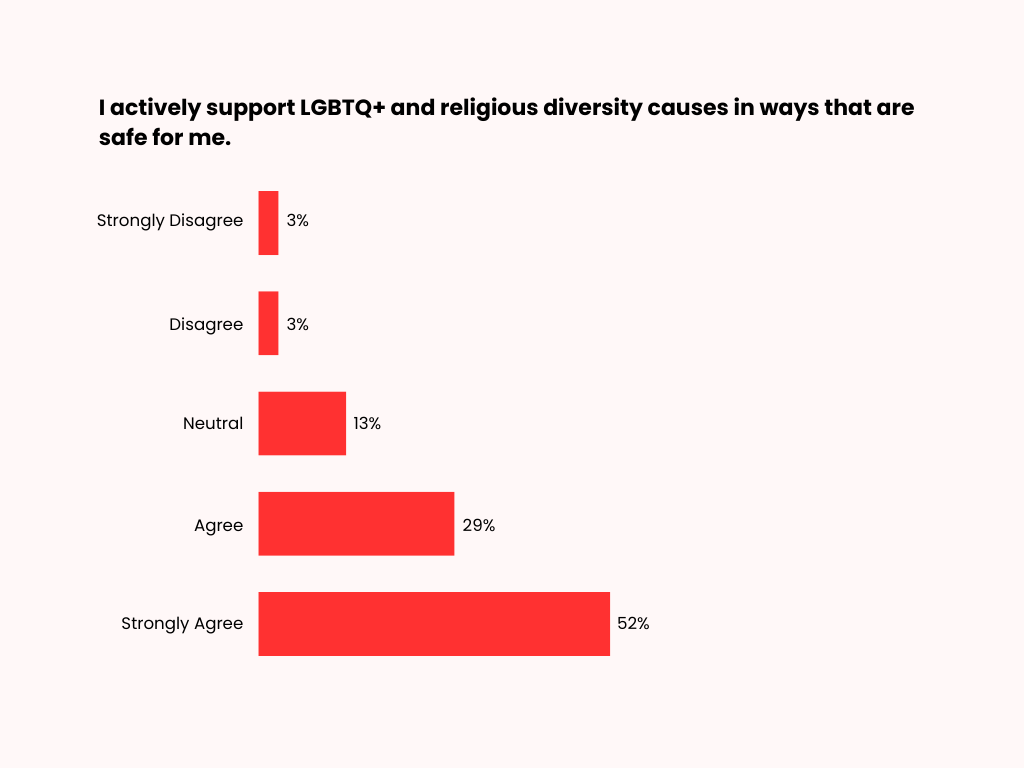
Respondents actively support LGBTQ+ and religious diversity causes in ways that are safe and anonymous. Fifty-two percent strongly agree that they do so, while 29% agree. Thirteen percent remain neutral, and only a small proportion disagree (3%) or strongly disagree (3%) with this statement.
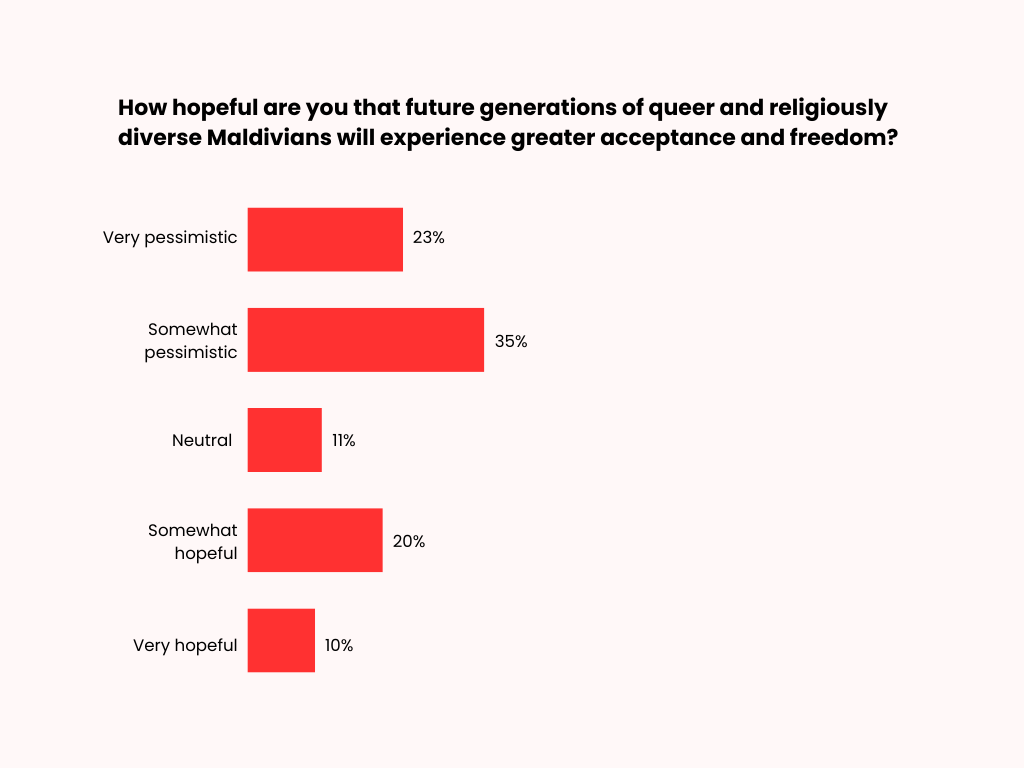
The majority of respondents feel somewhat pessimistic (35%) or very pessimistic (23%) about a future in which queer and religiously diverse Maldivians enjoy greater acceptance and freedom. Some respondents feel somewhat hopeful (20%) or very hopeful (10%), while 11% report neutral views regarding this statement.
Respondents have low confidence and a significant lack of trust in the state and view state institutions as unsafe and unlikely to protect LGBTQ+ and religiously diverse Maldivians from harm. This creates a situation where abuse often goes unreported and unchallenged. There is strong support for diversity, inclusivity and equal rights for all Maldivians regardless of gender identity, sexual orientation or religious belief (or lack thereof), as well as inclusive education and positive media representation.
However, there is a striking gap between the strong values held by respondents and action that is constrained by fear; nearly half of all respondents indicate they would engage in advocacy if it was anonymous and safe. Many have also spoken up but feel unsafe doing so. Despite strong solidarity and values, expectations and hope for structural change remain low.
Perceptions of the international community
International recognition and intervention play a crucial role in shaping the experiences of marginalized communities. For queer and religiously diverse Maldivians, external awareness and support can influence both advocacy efforts and local human rights conditions. This section examines respondents’ perceptions of the international community, including governments, media and human rights organisations, and explores the extent to which they believe global actors understand their realities, provide support and should take action to address human rights challenges in the Maldives.
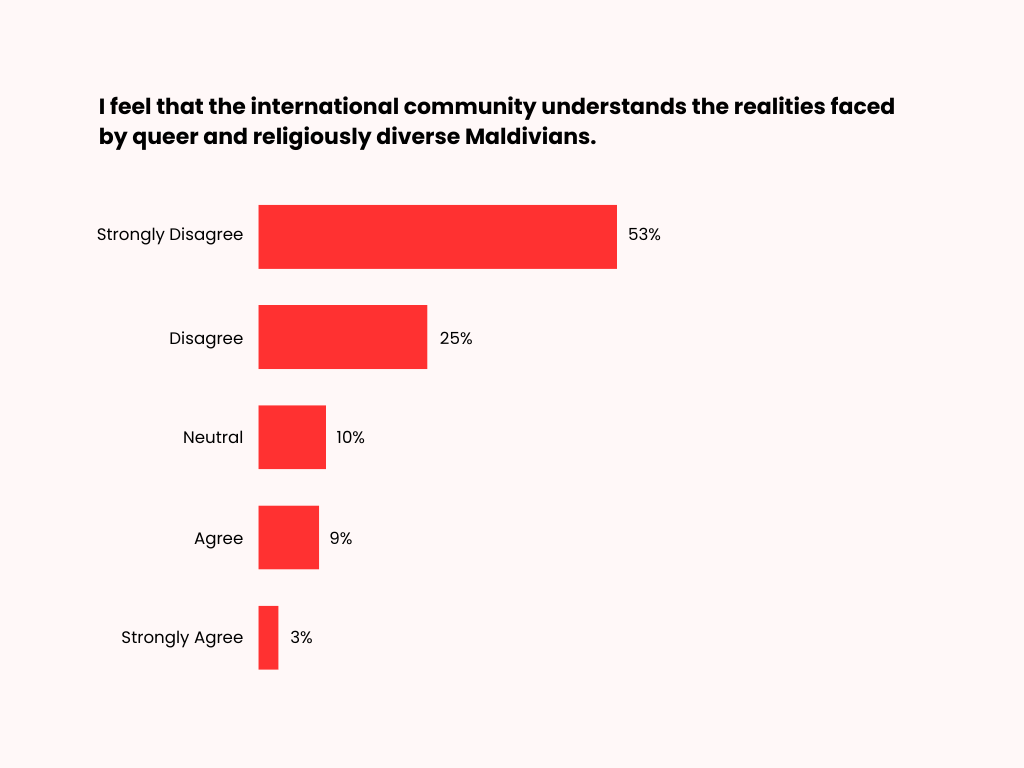
Most respondents strongly disagree (53%) or disagree (25%) that the international community understands the realities faced by queer and religiously diverse Maldivians. Ten percent remain neutral, while a small proportion agree (9%) or strongly agree (3%).

Generally, respondents do not feel that the international community provides sufficient support for queer and religiously diverse Maldivians. Sixty-one percent are not aware of any international support, while 31% feel that existing support is inadequate. A small proportion believe there is some support but that more could be done (6%), and only 1% feel adequately supported.
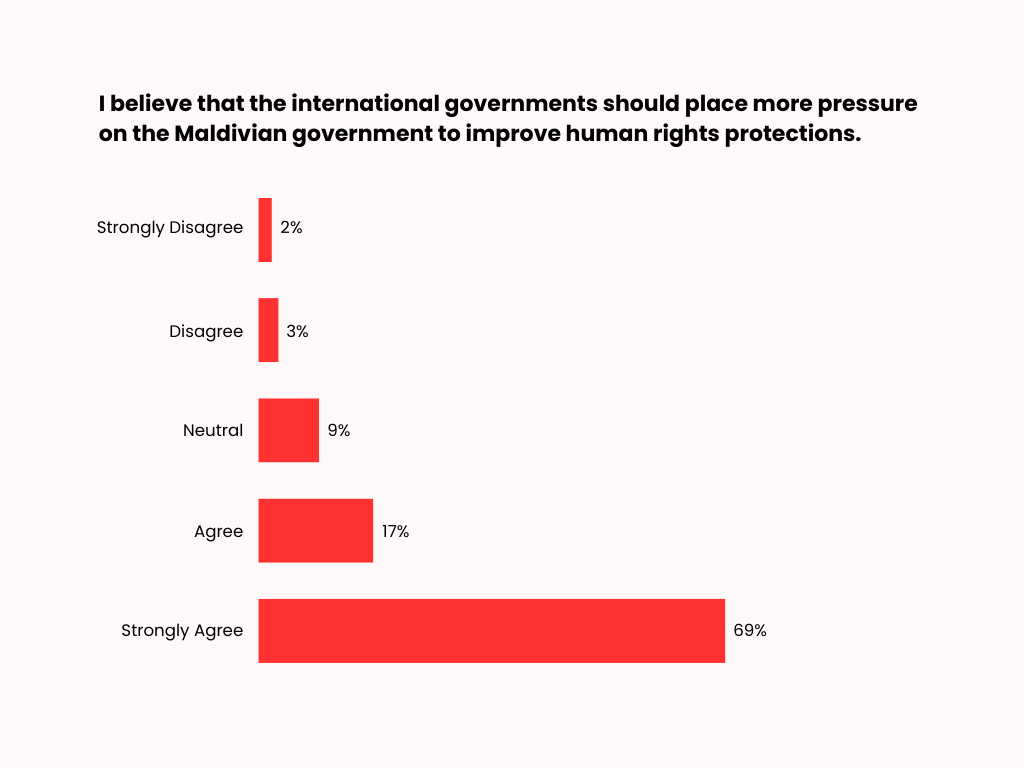
Most respondents either strongly agree (69%) or agree (17%) that international governments should place greater pressure on the Maldivian government to improve human rights protections. A smaller proportion of respondents report neutral views (9%), while few disagree (3%) or strongly disagree (2%).
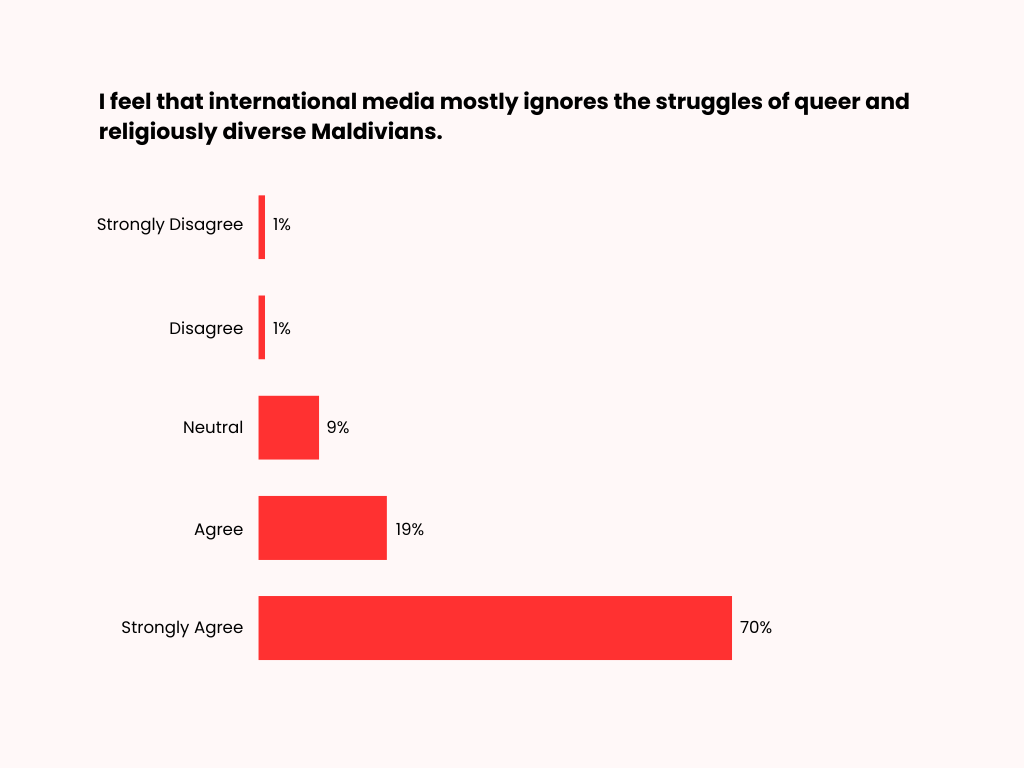
Seventy percent of respondents strongly agree that international media largely ignores the struggles of queer and religiously diverse Maldivians, while 19% agree. Nine percent remain neutral, and only a small proportion disagree (1%) or strongly disagree (1%).
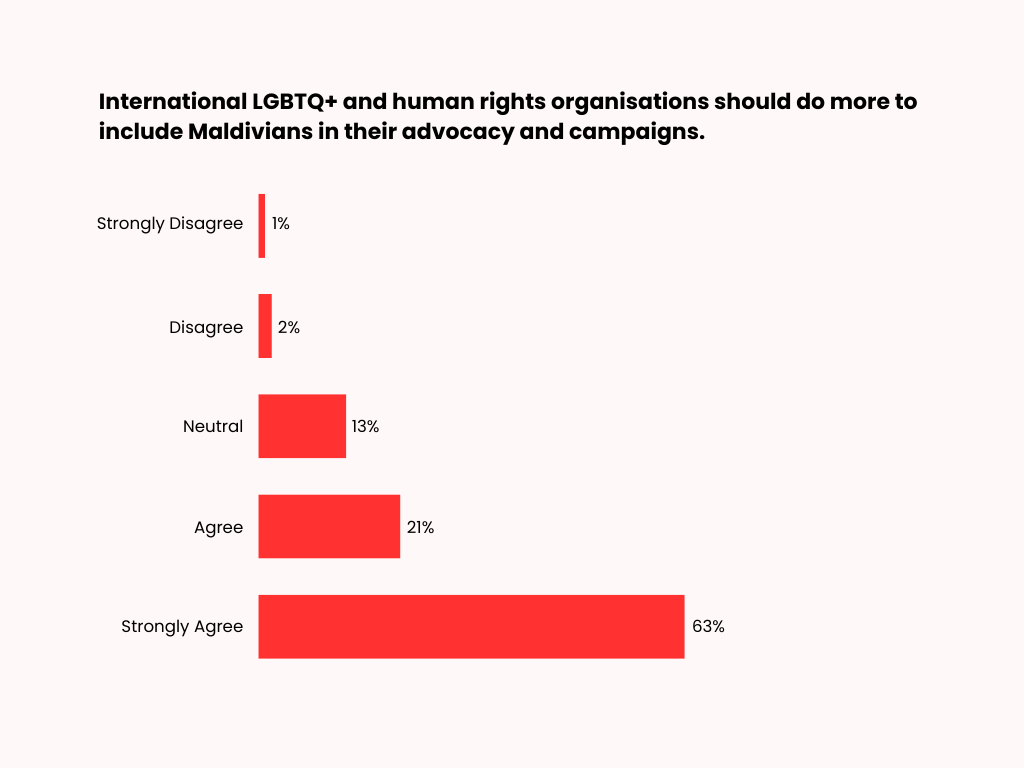
Most respondents strongly agree (63%) or agree (21%) that international LGBTQ+ and human rights organisations should do more to include Maldivians in their advocacy and campaigns. Thirteen percent remain neutral, while only a small proportion disagree (2%) or strongly disagree (1%).
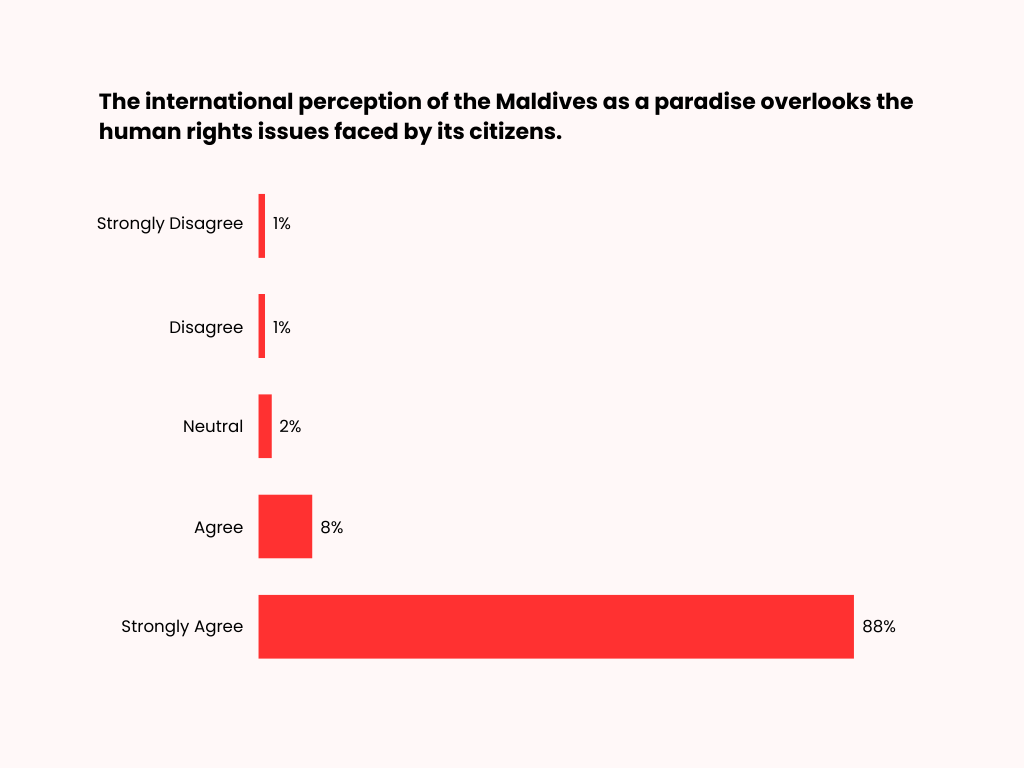
The majority of respondents strongly agree (88%) that the international perception of the Maldives as a paradise overlooks the human rights issues faced by Maldivian citizens. Some respondents agree (8%), while a small proportion remain neutral (2%) or disagree (1%) or strongly disagree (1%).
Respondents overwhelmingly perceive the international community as largely unaware of, and insufficiently supportive toward, the challenges faced by queer and religiously diverse Maldivians. Most feel that international governments, media and human rights organisations should exert greater pressure, increase visibility and more actively include Maldivians in advocacy efforts. The widespread perception that the Maldives’ “paradise” image obscures serious human rights issues and point to a significant gap between global narratives and local realities.
Summary
The 2025 Laadheenee.com Survey on the Experiences of Queer and Religiously Diverse Maldivians reveals a pervasive gap between formal narratives of tolerance associated with the Maldives’ international image as welcoming tourist destination and the everyday realities experienced by queer and religiously diverse Maldivians. Respondents report widespread fear, routine concealment of identity and frequent experiences of discrimination, as well as minimal trust in legal protections and state institutions.
While strong normative support for equality, inclusive education and positive representation is evident, opportunities for visible advocacy are significantly constrained by fear of harm and reprisal. Support is largely located within informal peer and online networks rather than institutional frameworks, reflecting both resilience and systemic failure. Despite resilience and shared visions for a more just society, expectations for meaningful structural change remain low.
Collectively, these findings highlight the deeply structural nature of exclusion in the Maldivian context and underscore the need for legal reform, strengthened protections and international engagement that is informed by and accountable to the lived experiences of queer and religiously diverse Maldivians.
Post artwork – “Chiral” by Burakashi (2024)
 The Laadheenee