This essay by Burakashi explores the paradox faced by queer Maldivians who live in an idyllic tourist destination yet confront severe legal and societal repercussions for their identity. It consists of five parts detailing the oppressive environment created by historical and ongoing political and religious dynamics. Despite becoming a popular destination for queer tourists and travel influencers, queer Dhivehin remain hidden, facing discrimination and violence. Burakashi critiques the complicity of tourists and the global community in perpetuating this cycle of erasure and suffering.
- Part 1 – Born to Paradise
- Part 2 – Islands as prisons and Maumoon’s legacy
- Part 3 – 100% Dhivehin and the Penal Code
- Part 4 – The time is not right
- Part 5 – Life in the Shadows of Guilt Free Capitalism
All photographs unless otherwise credited are by @burakashi / @kashiveli.archives.
Part 1 – Born to Paradise

Queer Dhivehin face a unique situation. On the one hand we are born into “paradise”, blessed to live in one of the world’s premier luxury tourist destinations. A place where tourists around the world, of all nationalities, genders, and sexualities are pampered and spoiled. On the other, being queer is illegal and socially unacceptable to the point where you will not find any locals living openly or even any locally based queer / LGBTQ rights focused NGOs. LGBTQ+ Maldivians are not having joyous weddings and honeymoons on the beaches of their homelands. Same-sex marriage, and same-sex sexual relations and intercourse are explicitly banned under the Maldivian penal code. When targeted and harassed, queer Maldivians cannot call on the police for help as do to so would result in self-incrimination.
Meanwhile, a google search for something like “gay Maldives” will bring up a plethora of articles from queer and gay travel influencers and writers justifying their visit while encouraging others to do the same. They had a great time, why shouldn’t you?
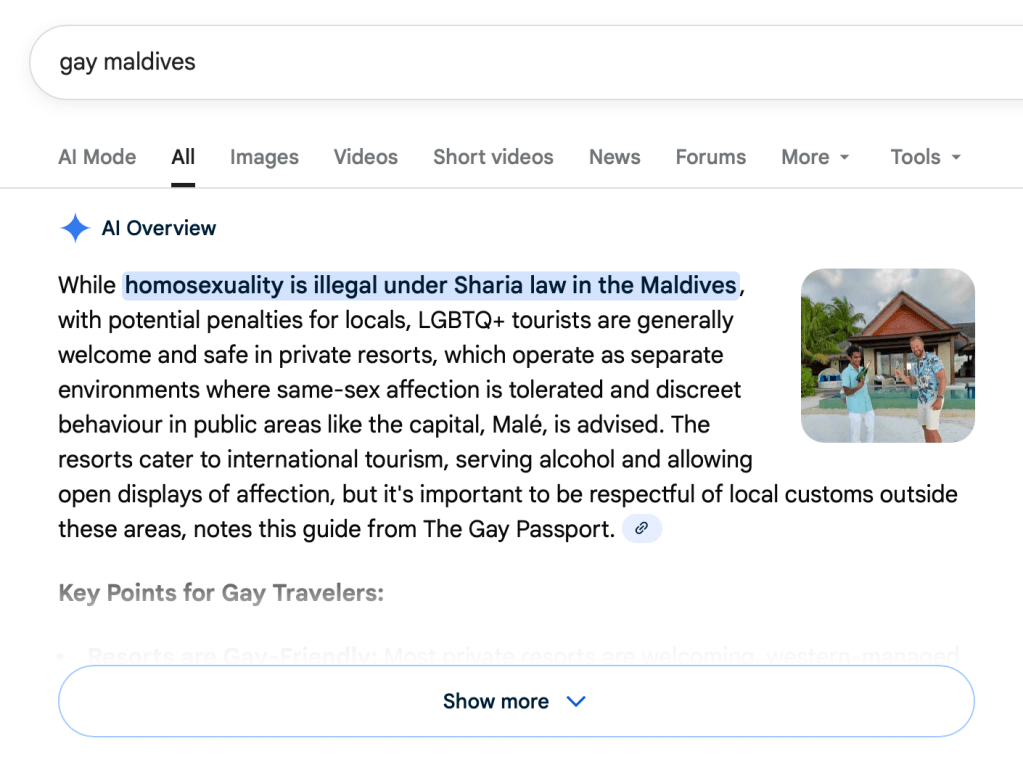
They will insist that the Maldives, despite first appearances, is very friendly and inclusive to gay tourists. They will sometimes offer a crumb of sympathy about how being gay is illegal if you are a local, but it will all be framed in the context of how these pesky local laws and attitudes might affect their vacation.
They will say how public displays of affection like holding hands and kissing are okay within the confines of the resort, but that you should be sure to “respect the local laws and customs” when on “inhabited” islands. They will write about their experiences with Search Engine Optimised titles such as “Being Gay in the Maldives”, as if their vacation gives them authority to speak on the lived experiences of queer and gay Maldivians.
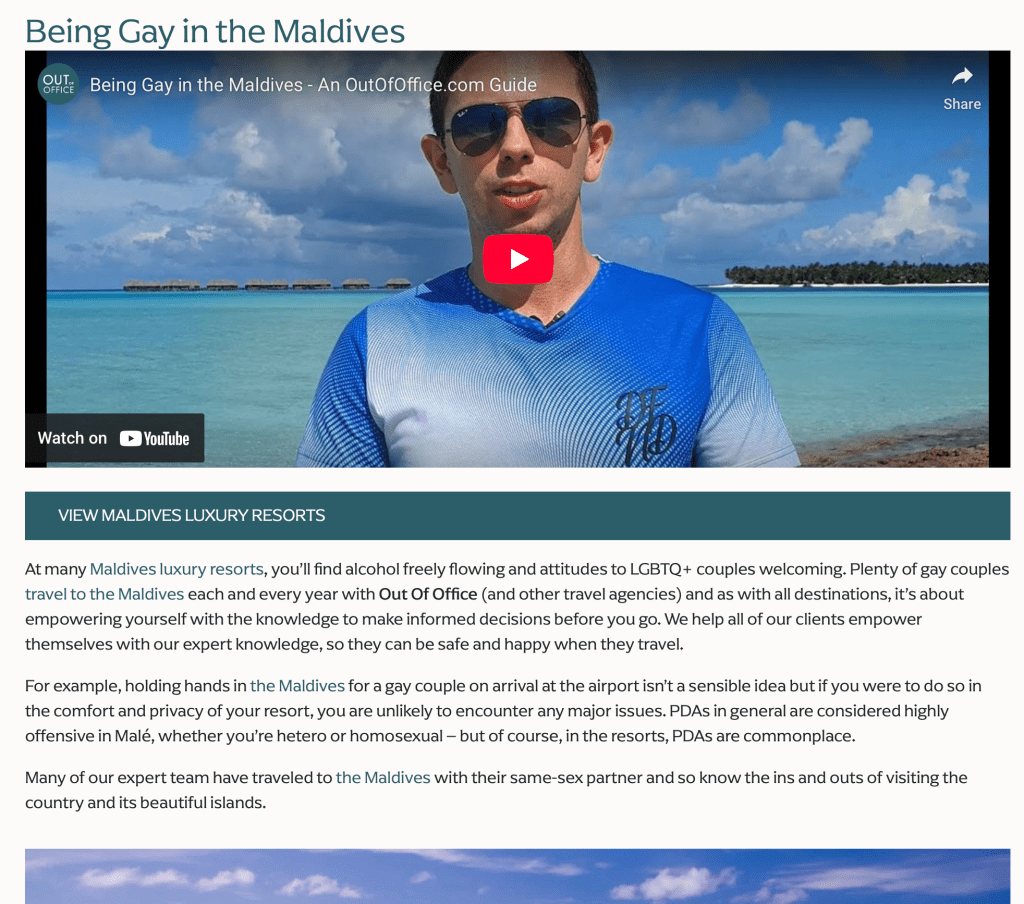
The resort islands are bubbles where the illusion of the ultimate vacation is maintained. You can hold hands and kiss your lover, and celebrate your honeymoon or long awaited vacation, sharing your love openly on social media, perhaps even creating some aspirational motivational content about how you’re living your #dream, all while being shielded from the reality that a local doing the same on an inhabited island would be arrested, labeled, and ostracised.
It could be argued that the same could happen to a tourist, if they were to try their luck being out and proud with the Maldivian public, away from the “safety” of the resorts, but they would simply be detained and deported. They wouldn’t have to keep living on a tiny island dealing with the consequences of expressing their love and identity in public.
The same goes for tourists who immediately open up hook up apps like grindr the moment they land. They might find a local, they might have a fun time, but if both were caught it would be the local who will ultimately be left behind in #paradise.
Part 2 – Islands as prisons and Maumoon’s legacy
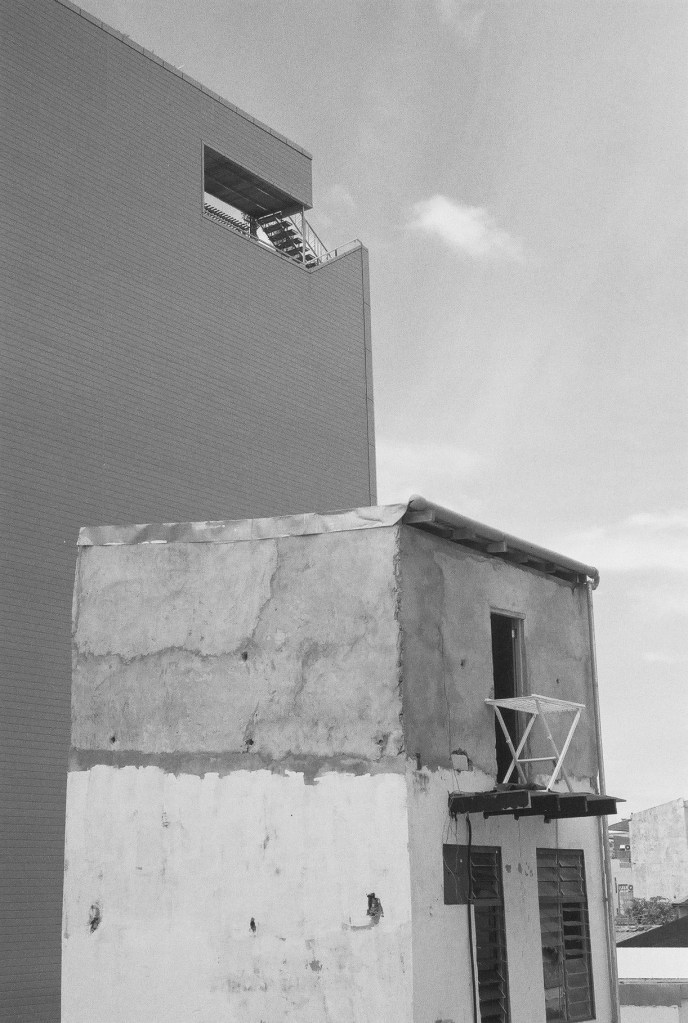
There is very little thought given to how the same mechanisms that make a resort safe is what makes local islands so dangerous.
A resort is designed to keep the locals out.
Meanwhile an “inhabited” island is designed to keep you trapped. An island is a natural prison.
There is nowhere to run. You can only leave via boat or seaplane. And to where would you escape? The Maldives is mostly ocean. There is no vast countryside to flee to. Maldivians are also a very connected people, everyone is seemingly perpetually online and news spreads fast. Another tiny island, no matter how far from where you are running from, will not be a viable refuge.
It is these very same principles of compartmentalisation and isolation that Maumoon Abdul Gayoom exploited during his heyday to torment Maldivians while hiding his true nature from the world. His 30 year rule, from 1978 to 2008, would see the development and rise of the Maldives as a luxury tourist destination, all while crushing and eliminating all dissent.
Then, much like now, tourists would land at the international airport and head straight to their resorts. Resorts that are fully self contained islands that only house the resort staff and guests. No locals would be present unless they were also staff or sometimes guests themselves. The only interactions with locals would be through opt in and very curated tours to nearby islands and the tourist area of Malé.
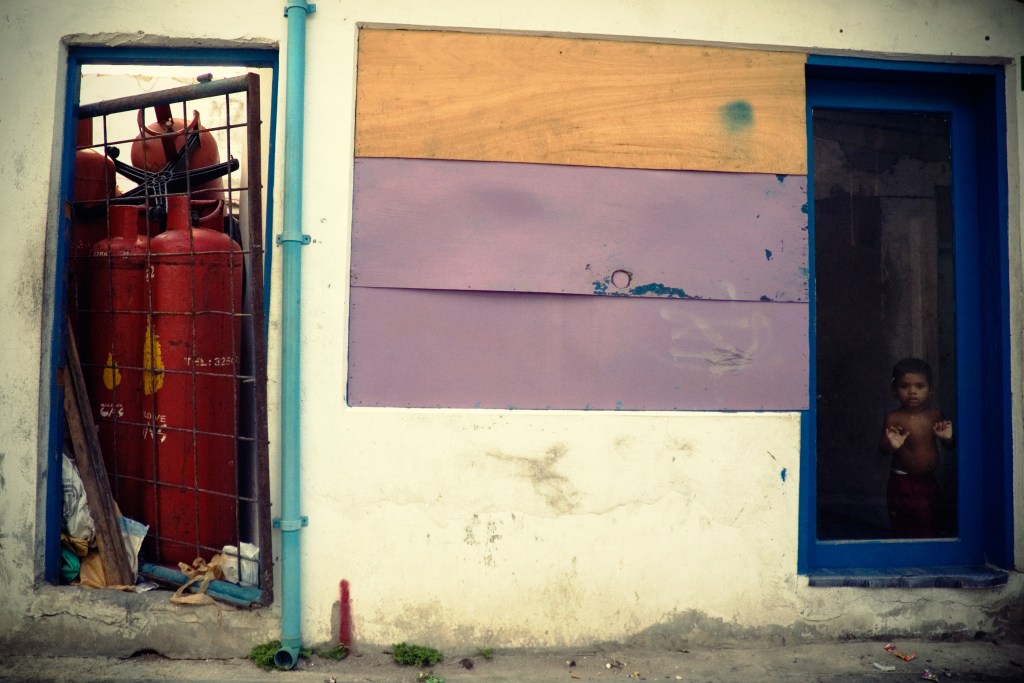
The classic resort system’s separation of local life and tourism was the main draw for tourists, who payed top dollar for a “real” getaway where it would be just them, pristine beaches and oceans, and their developing world servants pampering them. An escape from the demands of the first world to paradise, to the “sunny side of life”.
Hence the distinction between a resort and an “inhabited” island. Resort islands are for tourists, and inhabited islands are for locals. It remains to be seen how or if the relatively new guest house system – with tourists directly staying on inhabited islands – will change things.
Maumoon exploited our geography, using islands to create separate realities where local life could be controlled and maintained while offering up the illusion of paradise to cashed up tourists who knew better than to ask too many questions. Political enemies were crushed, dissidents were tortured, and tight control over religion and people’s personal lives was maintained. All of this while endless planes flew in and out, bringing in tourists so flush with cash that the Maldives would soon become the country with South Asias highest GDP. The capital, Malé City, was developed while other more rural islands (collectively referred to as “Raajjé theré rahthah” – islands within the kingdom), were intentionally left behind.
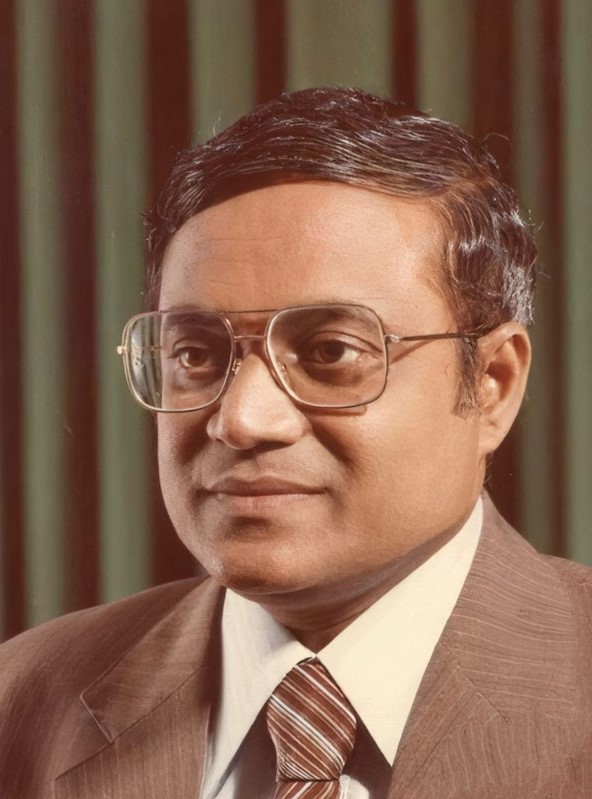
People like to see this era through rose tinted glasses and mistakenly assume that Maumoon himself was progressive because he did things like ban the niqab and arrest and torture Salafi / Wahabbi preachers. He was against these more “extreme” versions of Islam not because he was progressive but because he wanted to control the thoughts of the populace. Rival preachers representing other beliefs and interpretations were a direct threat to his iron grip.
Let’s not forget that Maumoon is someone who liked to personally lead the entire nation during weekly Friday prayers. He was not just a dictator, but also a holy man. As a child I was lucky enough to attend one of these sessions, and doubly lucky to shake his hand as he was leaving. It felt like I had shook hands with god himself.
Ironically his fall from power would give many more freedoms to Salafists but not to those who actually preached acceptance and tolerance of diversity within the Maldives. And most certainly not to atheists and people who believed in other religions.
It is 2026 and the Maldives is still functionally a theocracy. Maumoon Abdul Gayoom’s dictatorship may be over, but his legacy of entwining national identity, politics, and religion remains.
For some reason it is surprising to most people that the Maldives still does not have freedom of thought / conscience / religion. Foreigners somehow assume that this changed when the dictatorship fell. The Maldives constitution states now, just like then, that all Maldivian citizens must be “Muslim”.
The reality is that freedom of religion was and is not something desired by any Maldivian politician. In fact it is the opposite, with the accusation that your opponent is trying to bring freedom of religion being a common way to slander your opponent.
When Mohamed Nasheed came to power in 2008, the most common accusation thrown at him was that he was “laadheenee” or irreligious. If only this were reflected in his policies and governance. After being elected, he renamed Maumoon’s Supreme Council for Islamic Affairs to the Ministry of Islamic Affairs, which was then promptly handed over to his coalition partners the Adhaalath Party. The Ministry, under the leadership of Minister of Islamic Affairs Abdul Majeed Abdul Bari, would continue Maumoon’s tradition of suppressing any voices seen as going against the governments interpretation of the “dheen” (religion).
You could attempt to push the boundaries of what was acceptable, but any backlash, and you would be on your own. This was exemplified in what happened to Mohamed Nazim, who declared himself an atheist at a public gathering in 2010, a good two years after the fall of Maumoon. His status as the fledgling democracy’s first publicly known apostate lasted all but a week before he repented and reverted while in police custody. You can read more about this incident here: Mohamed Nazim’s 2010 confession – a turning point for Maldivian minorities.
At the end of the day, so called laadheenee people were no more free under Mohamed Nasheed’s democracy than they were during Maumoon’s dictatorship.
Part 3 – 100% Dhivehin and the Penal Code
Nationalism and religion are still so entwined in the Maldivian mindset that many Maldivians still parrot the dogma popularised by Maumoon that the Maldives is a “100% Islamic/Muslim” nation. Not 100% Dhivehin (islanders), but 100% whatever the government at the time decides counts as being “Muslim”.
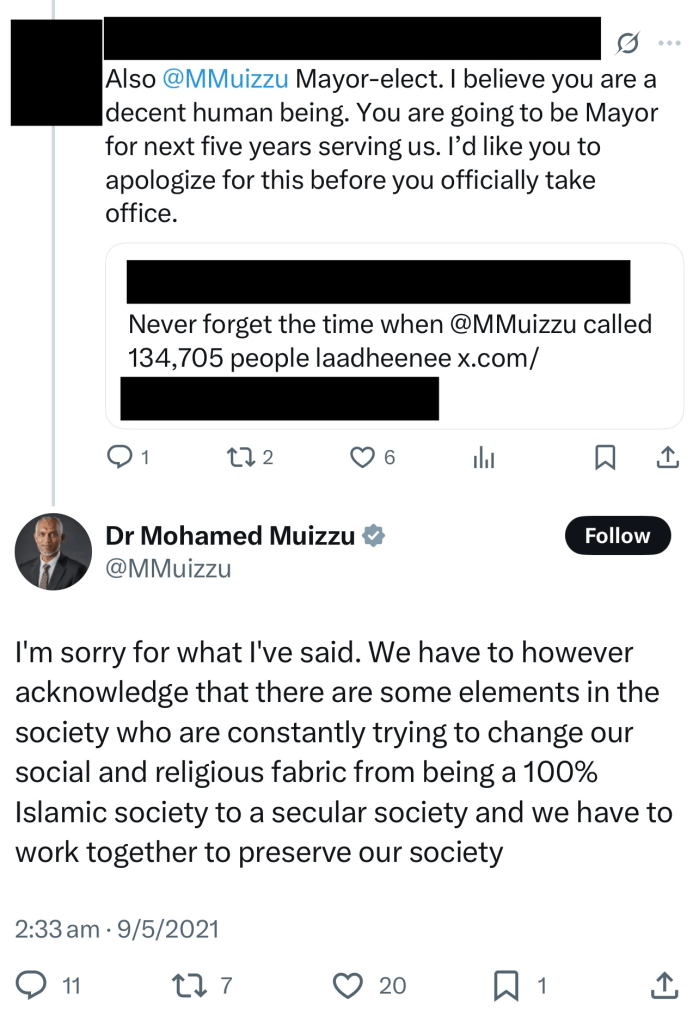
How do you maintain the illusion of the 100%? Of pure homogeneity of faith, of a place where everyone is cis-gendered, straight, and just exactly the right kind of Muslim?
The Maldivian penal code directly references homosexuality under Chapter 410 – Offences Against the Family [ އާއިލާއާ ދެކޮޅަށް ކުރެވޭ ކުށް] (Aailaa aa dhekolhah kurevey kuh’) [Archived link] [English translation by University of Pennsilvania – note that this translation has slight errors]
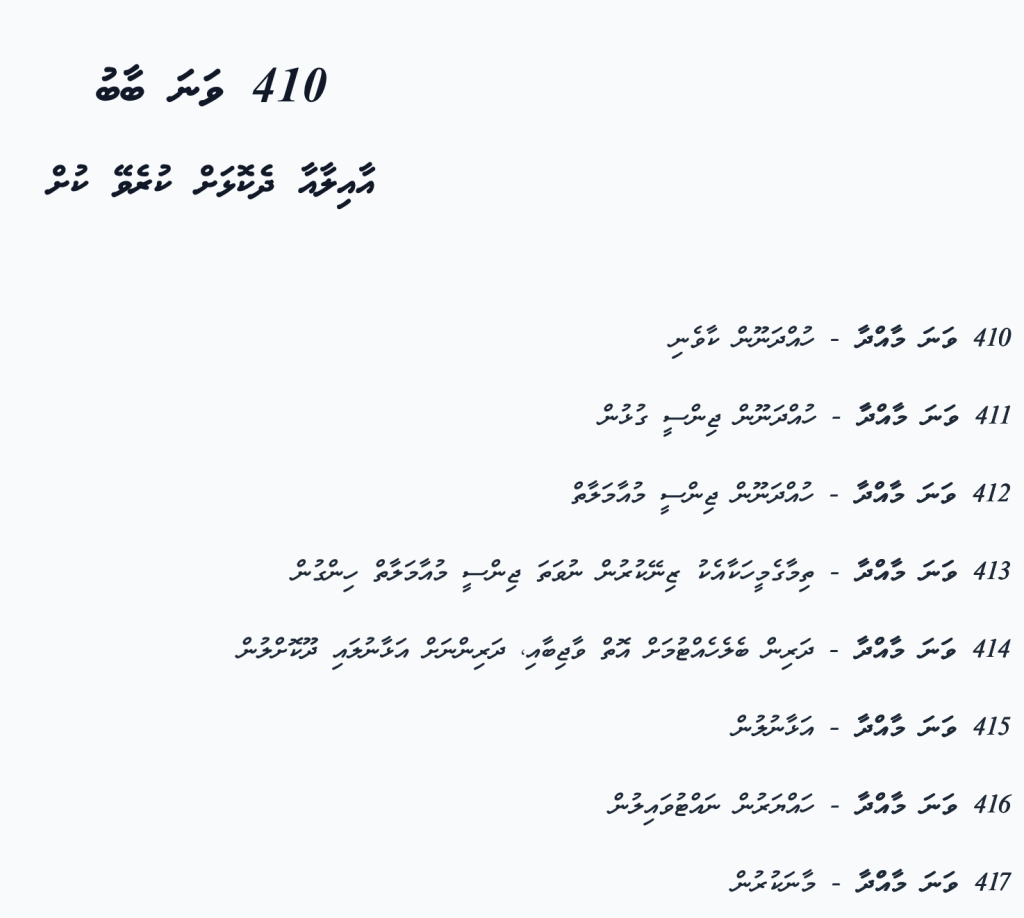
This chapter contains sections 410 to 417. These are as follows:
- Section 410 – Unlawful Marriage [ހުއްދަނޫން ކާވެނި] [hudhanoon kaiveni]
- Section 411 – Unlawful Sexual Intercourse [ހުއްދަނޫން ޖިންސީ ގުޅުން] [hudhanoon jinsee gulhun]
- Section 412 – Unlawful Sexual Contact [ހުއްދަނޫން ޖިންސީ މުއާމަލާތް] [hudhanoon jinsee muaamulaai’
- Section 413 – Incest [ތިމާގެމީހަކާއެކު ޒިނޭކުރުން ނުވަތަ ޖިންސީ މުއާމަލާތް ހިންގުން] [thimaage’ meehakaa eku ziney kurun nuvatha jinsee muaamalai’ hingun]
- Section 414 – Child Abandonment and Parental Duty of Care [ދަރިން ބެލެހެއްޓުމަށް އޮތް ވާޖިބާއި، ދަރިންނަށް އަޅާނުލައި ދޫކޮށްލުން][dharin belehettumah oi’ vaajibaai, dharinnah alhaanulai dhookohlun]
- Section 415 – Non-Support [އަޅާނުލުން] [alhaanulun]
- Section 416 – Abortion [ހައްޔަރުން ނައްޓުވައިލުން] [haiyarun nattuvailun]
- Section 417 – Definitions [މާނަކުރުން] [maanakurun]
Here, under section 410 are listed the following Class 1 misdemeanours (Imprisonment for not more than 1 year, with a maximum fine of MVR 50,000). I have left them all to provide more flavour and context to the Maldivian legal system.
- (a) Unlawful Marriage. A person commits an offence if:
- (1) being already married to four wives, or during the post-marital waiting period of one of the four wives, he marries again,
- or
- (2) being already married, or during the post-marital period of his divorced wife, he marries a sister of one of his current wives; or
- (3)within the post marital period, a woman marries a man other than the man who divorced her; or
- (4) being already married, a woman enters into a second marriage; or
- (5) a woman divorced three times, marries the same man who divorced her, without getting married to another man and being divorced by him; or
- (6) two people divorced due to adultery getting re-married
- (7) a man and woman whose marriage is forever prohibited in Islamic Sharia due to them being close relatives, or being nursed by the same woman, or due to marital relations, enters in to a marriage; or
- (8) two persons of the same sex enter into a marriage; or
- (9) a woman gets married to a non-muslim man; or
- (10) a man gets married to a non-muslim woman not belonging to adherent faiths which have revealed scripture.
Section 410 – Unlawful Marriage [hudhanoon kaiveni] states that (a) “A person commits an offence if:” (8) “two persons of the same sex enter into a marriage”. How lovely then, that the Maldives is steadily growing in popularity as one of the most desired luxury destinations for queer couples to spend their honeymoon.
Furthermore Section 411 – Unlawful Sexual Intercourse [hudhanoon jinsee gulhun] states that (a) “Unlawful intercourse. A person commits an offence if:” (1) “he engages in sexual intercourse outside of marriage (ziney kurun)” and (2) “he engages in sexual intercourse with a person of the same sex”.
“Same-sex intercourse” (Eh’ jinsun jinsee gulhun hingun) is defined as:
- (i) Insertion by a man his sexual organ or any object into the anus of another man for sexual gratification. Or the insertion into another mans mouth the penis of a man or
- (ii) Insertion of a woman’s organ or any object into the vagina or anus of another woman for sexual gratification.

We should note that the only genital organ or area referred to by name in the dhivehi text is the penis, which is called a “zakaru” (a formal word rarely used by the public, who almost universally refer to a penis as a “foah” [arecenut]). “Anus” is referred to as “backside door/entrance” (furagas dhoru) and vagina as “frontside door/entrance” (kurimathi faraathu dhoru).
This crime of “unlawful intercourse” is further broken down into the following grading:
- Adultery and Fornication. The offence in Subsection (a) is:
- A Class 5 felony if the person is married and has intercourse.
- A Class 1 misdemeanour if the person is unmarried and has intercourse with a person married to another.
- A Class 2 misdemeanour if the person is unmarried and has intercourse with an unmarried person.
- A Class 4 felony if the person married or unmarried has sexual intercourse with a person with whom marriage is prohibited by virtue of being a close relative, or being nursed by the same woman, or due to marriage.
- A Class 3 felony, if the person holds a special place in the family and has misused such position, even if the person is not prohibited by virtue of being a close relative, or being nursed by the same woman, or due to marriage
From this we can infer that same-sex intercourse between unmarried people is classed as a Class 2 misdemeanour (imprisonment for not more than 6 months, with a maximum fine MVR 24,000). Meanwhile a married person who has same-sex intercourse will be charged with a Class 5 felony (imprisonment for not more than 2 years, with a maximum fine of MVR 100,000).
Furthermore there is a clause that states “in addition to the punishment authorised under Chapter 90, to impose the penalty prescribed under Islamic Sharia, an additional punishment of 100 lashes is authorised for the offence.” This appears to apply regardless of grading.
“Lashes” are defined as “the symbolic punishment of striking an offender’s back with a short length of rope in a manner not designed to cause bodily injury. A single person must inflict all of the lashes prescribed as punishment, and he may only drive the rope using his wrists; he may not use any other part of his arm or movement in his shoulders, hips, back, legs or torso for that purpose.” How compliance to these standards are ensured is unclear.
Furthermore, Section 412 – Unlawful Sexual Contact [hudhanoon jinsee muaamulaai’] states that (b) “A person engaging in sexual contact with a person of the same sex is committing an offence.” and that (b) “prohibited sexual contact” means indecent acts other than the offences prescribed under Section 411 (a) of this Code, with a person of same sex, or with a person of the opposite sex other than with a person to whom he is married, or with an animal, for obtaining sexual gratification.” This has a similarly complicated grading system to define the level of crime.
Ultimately the Maldives has a legal system that simultaneously denies your existence as a queer person while reducing your queerness to nothing more than acts of “unlawful” sex.
Thus to be gay is to not only be a criminal, but to also be a sinner.
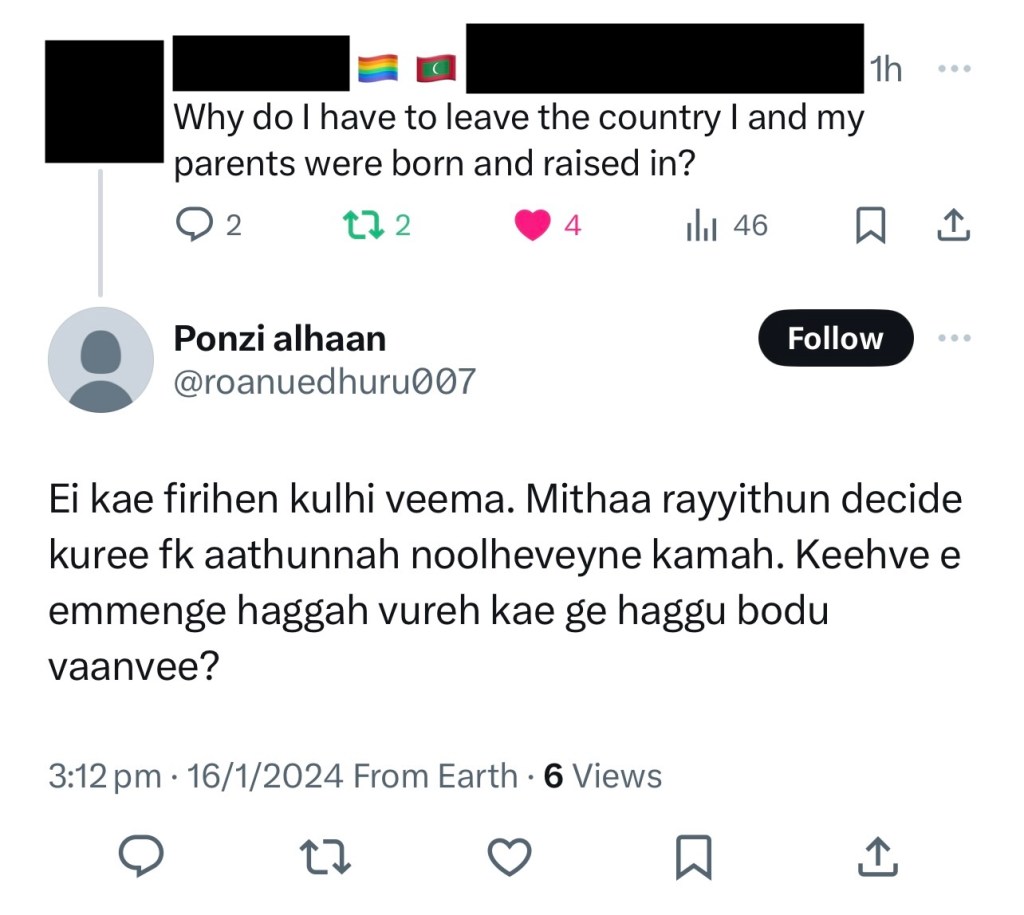
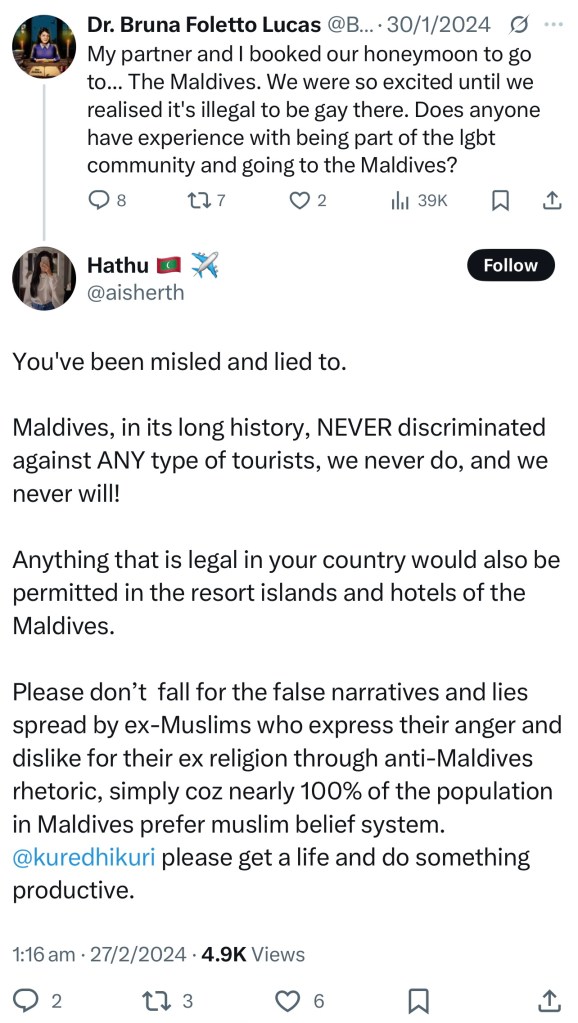
So, to maintain the purity of this 100%, sinners and criminals must be excluded from the equation. Maldivians are pure and holy, and pure and holy people can’t possibly be firihen kulhin. Therefore if you are gay, you are no longer Maldivian, as to be Maldivian you need to be Muslim, and Muslims would never be gay. To consider the existence of Maldivians that are both queer and Muslim is heresy.
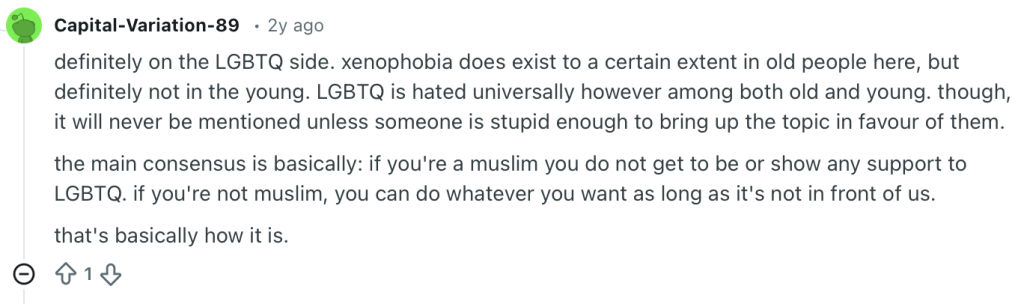
Screenshot from reply to reddit thread “Is it safe for a gay couple to visit Maldives off the resorts?”.
And as queerness is reduced into these definitions of criminality and sin, there is no need to include queer, gay, or otherwise gender diverse Maldivians in the census, much the same way non-Muslim Maldivians are not included either.
Part 4 – The time is not right
It is not just the Maldivian government that practices this sort of erasure. “Human rights” NGOs rarely, if at all, include any questions relating to LGBTQ+ rights in their surveys and campaigns.
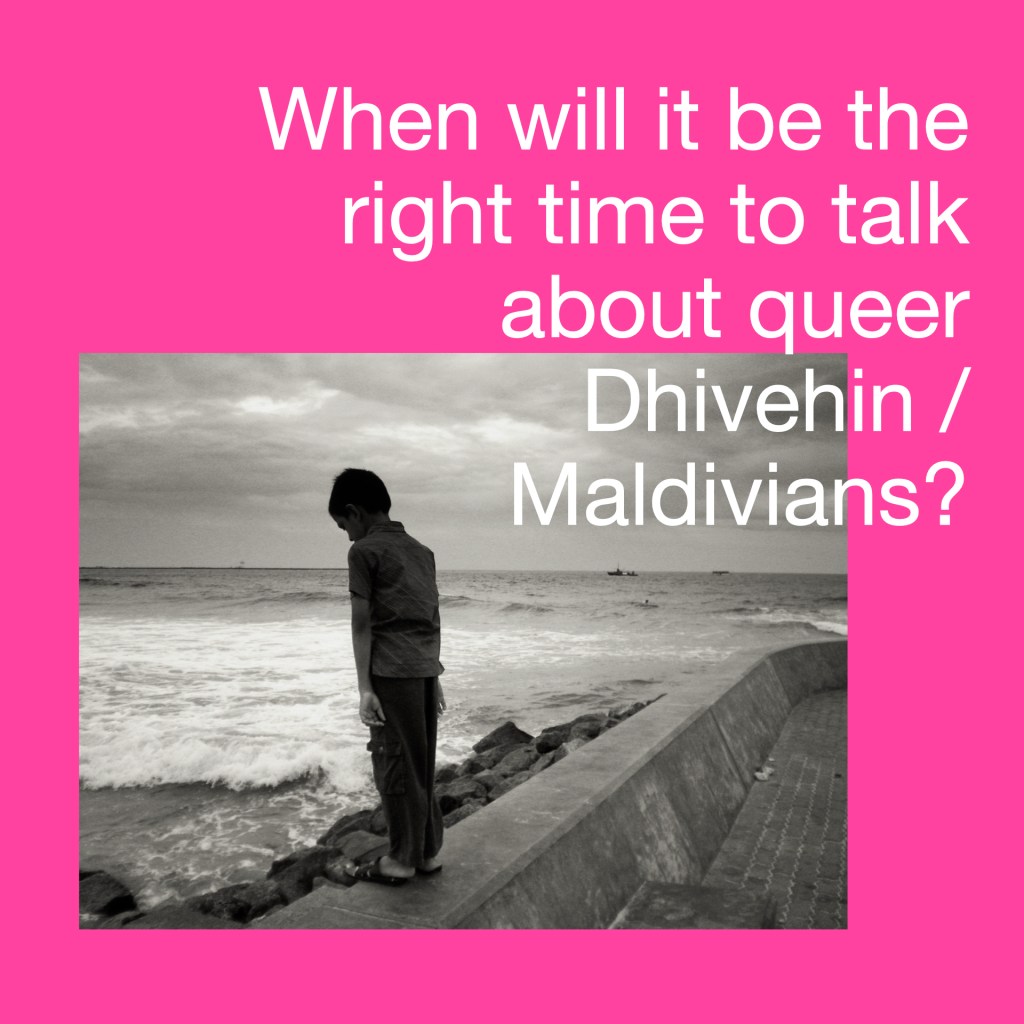
The common narrative is that this is to avoid backlash because the “time is not right.” Backlash from whom? In what form? And when will it be the right time?
The time was not right when I was a child during Maumoon’s dictatorship, when I was bullied in school for being a bit queer, and for having a name similar to “Honey”, a gender queer individual who faces constant harassment and discrimination to this day.
The time was not right when I was a teenager, just turned 18, and voting in the Maldives’ first ever multi-party elections. I still remember the ink on my finger.
The time was not right during Mohamed Nasheed’s presidency when Hilath Rasheed had his skull fractured, and then later when he barely survived having his throat slashed. I was so shocked and angry, and scared, and then relieved that he was somehow still alive. I was sure that this would be when people would start to speak up, but nobody did.
The time was not right when Dr Afrasheem Ali, one of the Maldives only progressive Islamic scholars, was killed.
The time was not right when Ahmed Rilwan AKA Moyameehaa and Yameen Rasheed – both possibly the last vocal mainstream supporters Maldivian diversity – were murdered. They were not just journalists, they were true allies.
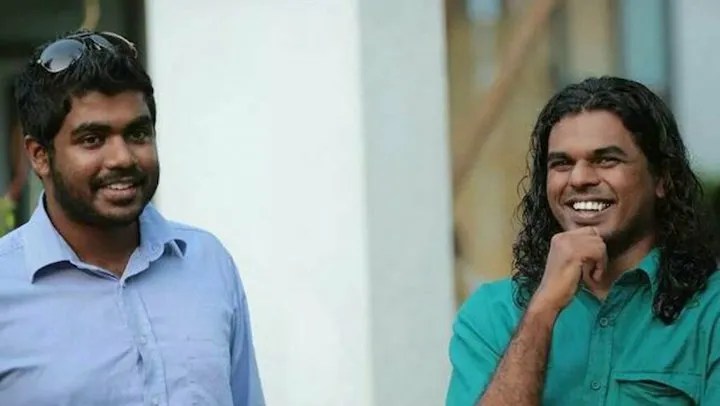
The time was not right when queer, gay, and trans dhivehin had to subsequently flee the country to avoid a similar fate.
And that is if you are lucky.
When confronted with the existence of queer Dhivehin, it is common for peaceful Maldivians to react diplomatically with the suggestion to leave. Leave to where your existence is more compatible with the “culture”. Leave before something bad happens. Leave before the violent ones find out.
“Leaving”, a fancy way of saying forcibly displaced, is not a privilege that is afforded to most Maldivians.
The luckiest are the elites who move abroad and simply live double lives, erasing their queerness when they visit their homes in paradise.
Less fortunate, but still unfathomably lucky in our own way, are people like me that had to navigate our way through the asylum system to become refugees.
We will never return “home”. I myself have stopped referring to the Maldives as “home” as it has become a lie that is too painful to repeat.
I could keep quiet about all this. Simply disappear into the ether like I never existed in the first place. It would probably be the better option in terms of my mental health. But it would also be convenient for the Maldivian government and the elites who rotate in and out of it. This bothers me. So I refuse to shut up. And so here we are. Another mouthy devil who has been exiled from paradise.
With that said I do not judge displaced Maldivians who simply chooses to disappear. You do not owe the world anything, but Dhivehin owe you some peace. Live your life and flourish.
Part 5 – Life in the Shadows of Guilt Free Capitalism
Then we have the apathetic tourists who fully believe they “deserve” a vacation in paradise. People who in their home countries would do things like buy free range eggs and organic produce, and avoid companies like Nestle’ in order to be “ethical consumers”.
The idea that gay marriage could be legalised in the Maldives is such a distant dream that it might as well be a fairy tale. Yet queer couples regularly visit the Maldives on their honeymoon.
Somehow it is okay that queer locals are treated completely different from queer tourists. When it comes to this ethical dilemma, “I earned this”, “I deserve this”, “us queers are denied so much, why this too”, “I can’t control what the government does”, “it’s not my fight”, and “I’ve already bought the tickets and besides it such a great deal, and aren’t those islands going to disappear because of climate change anyways?!” wins over “maybe there is something hypocritical about me so decadently enjoying this land that can’t be enjoyed the same way by locals just like me”.
This uncomfortable truth can be tolerated, guilt free, as it is simply the price of having the vacation they deserve. Their memories and posts about their vacation that they share will be about how clear the water was, how amazing and luxurious the resorts were, how the food was so delicious, and how pleasant their little curated interactions with the locals were.
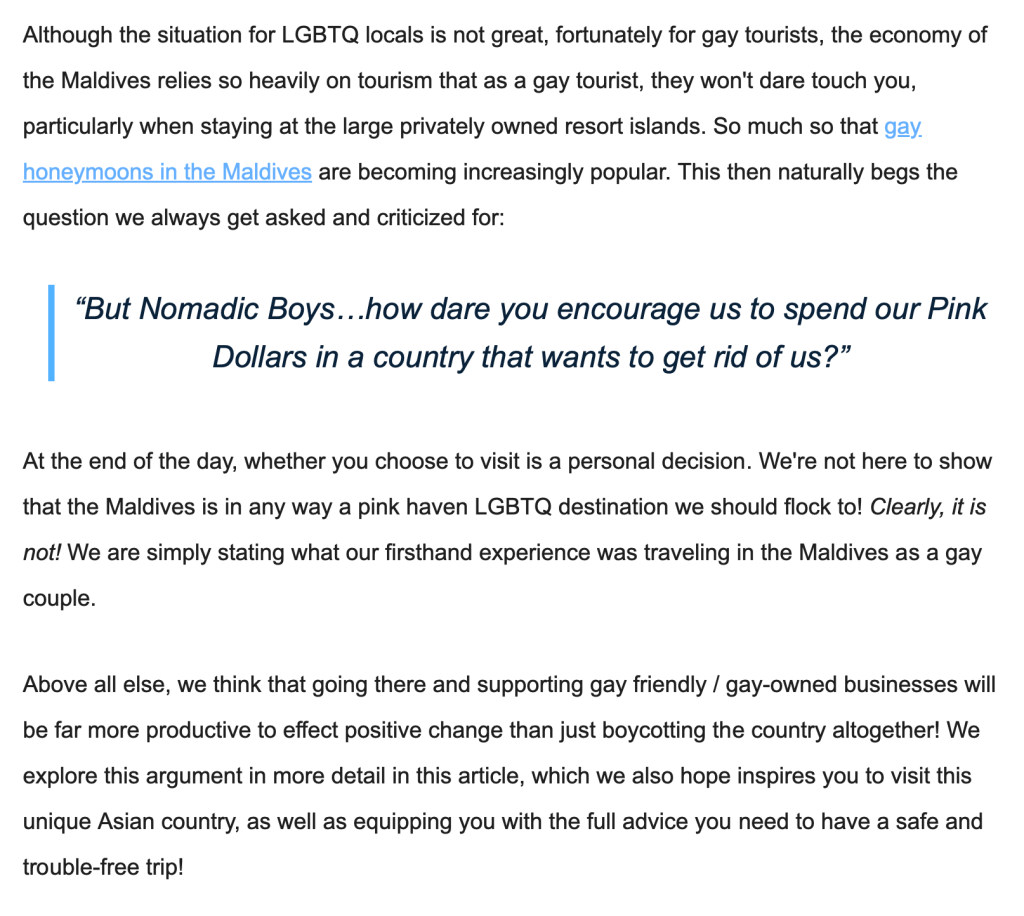
They might even frame their stay at their world class resort, often owned by global conglomerates, as “supporting local queer friendly businesses”.
These “queer friendly” businesses will not dare utter even a single word of the most performative support for queer locals as to do so would attract the same backlash from the locals that the human rights NGOs are so desperately trying to avoid. Let’s also not forget that Maldivan resorts, like the majority of Maldivian infrastructure, is built from the labour of underpaid and often trafficked immigrants.
Do you really think these resorts will help local queer people in danger? Do they have a helpline? Will they send over some buff room boys to fight for you? Will they fund your asylum? Will they help change local laws to be more inclusive?
They will frame their luxury vacation, of which their ultimate goal is to boost their profile as travel influencers, as some kind of altruistic sacrifice, that is “more productive” than a boycott, after which they will never mention us again.
They will not mention that, for a local, something as innocuous as taking a selfie with your lover is dangerous. I am not even talking about posting a selfie to social media. I am talking about simply having a selfie of you with your lover on your phone. What if the photo were to get leaked? It could very well lead you down the path of being outed, and ultimately having to flee or hide and suppress your identity even more rigorously and hope for the best. Calling the police will be of no help, they will simply arrest you instead, making a spectacle of your misery and outing you even further.
Queer tourists can use the Maldives natural beauty and global status for cultural capital, while queer Dhivehin are forced to live in secret in our own homeland. How is this not akin to some form of colonisation?
Queer and gay tourists will avoid these realities and instead focus on how they were ultimately safe. As if they are heroes for conducting pioneering research into just how much their pink dollars are worth at a world class five star luxury resort. The danger it seems, might even be a bit of a thrill for some people. They entered the belly of the beast and came out unscathed, and they believe in you so much that they think you can do it too, just make sure to like and subscribe.
They will neglect to mention the fact that this lack of violence does not negate the potential for it.
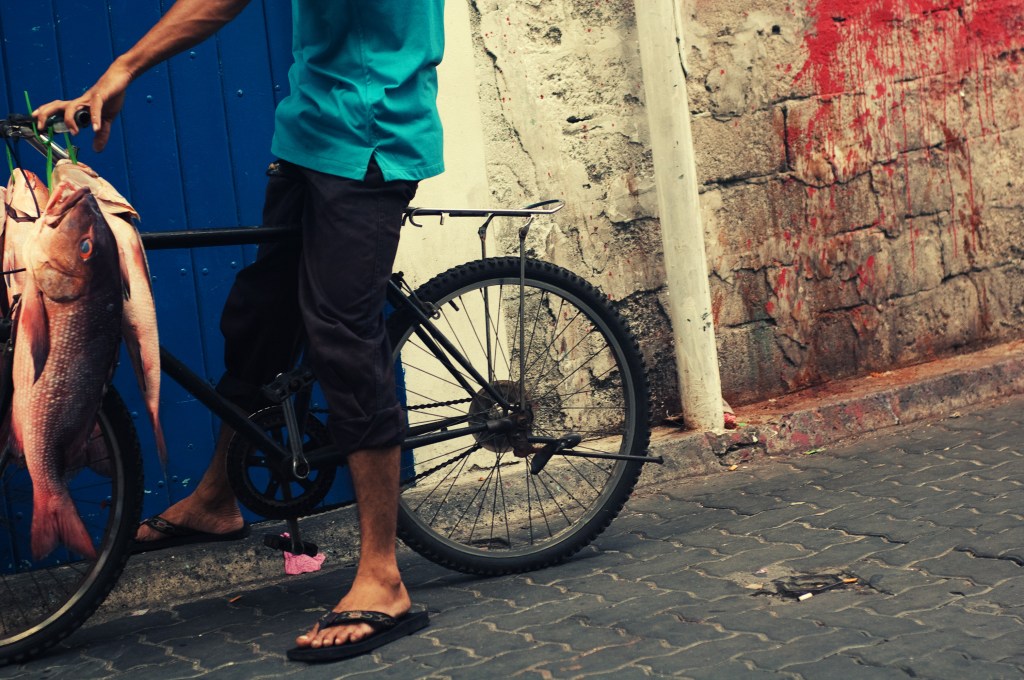
They will forget to ponder that hate crime statistics might not be accurate for a country where hate is legal and it is criminal to be yourself.
Their celebrations of love will drown out the inconvenient truth of our suffering. Mentioning us would really ruin the vibe. This is not the time for that. This is time for celebrating with an endless stream of selfies, reels, and stories.
You aren’t going to find the same types of celebrations from queer Maldivian lovers.
For us Dhivehi queers are experts at policing ourselves for our self-preservation.
We do not report harassment, stalking, outright violence, and hate crimes against us as there is no one we can trust to report them to.
We are rarely caught because we choose to live in the shadows as we have no other choice.
We are ever vigilant. We analyse everything we say, and everything everyone says about us. We double check every text, we make sure we’re using the right account for the right person, and we make sure our phones are locked and our photos are hidden. We are always looking behind our backs, we are always checking our peripheral vision, we are always worried about our friends. We never truly relax because we are never truly safe.
We do not fear the reality of climate change as much as the possibility of knives in our backs.
Unlike the travel bloggers whose entire brand is based on their queerness, we do not write queer or gay in our social bios unless we are anonymous or an out refugee like myself.
There is no in-between.
To this day you will not find a single out and proud Maldivian elite, despite us being more than a quarter into this century, and more than a decade into the fall of Maumoon’s dictatorship.
For the elites also police themselves, as to have a target on their backs would reduce or negate their ability to travel in and out of paradise. They are silent for the same reason that the so called queer friendly resorts are silent. They prize their mobility, familial wealth, social networks, and comfort over the rights of those less privileged than them. They would lose access to paradise, and all the riches it contains.
So we have no legal support. No support from apathetic tourists, and thus the wider international community, and no support from the local elites with the money and power to do something about it.
And no support from international journalists and human rights activists who don’t want their writing to cause them to potentially lose out on the occasional trip to heaven. It is not uncommon to see people whose entire persona is based on equality and justice boast endlessly about their magical trips to paradise. About how rejuvenating it was. About how it made them ready to get back to the daily grind of saving the world.
So what is there for us to do but suffer in silence? Greta Thunberg could save us from climate change and rising tides, but does it matter if we are all dead inside from the stress of having being born into paradise?
When will it be the right time to talk about queer Dhivehin?
 The Laadheenee